July 23, 2026
Various Artists
In Minor Keys
Venice Biennale 2026
May 5 - November 22, 2026
In Minor Keys
Reviewing the Venice Biennale is always a challenge. How does one make sense of the curatorial premise of the large group exhibitions in the Arsenale and the Central Pavilion in the Giardini in relation to the various national pavilions, as well as the numerous collateral events located throughout the city. As contemporary exhibitions are often seen in relation to historic Venice, it is a delight to view them together. One of the thrills of visiting the Biennale is seeing contemporary art in old churches and otherwise closed palazzos that have been reconfigured for new exhibitions.
As always the journey through the city and all the art it has to offer is best when one has numerous days and can leisurely stroll through the great variety of locations.
In 2024, Koyo Kouoh was selected as the first African woman to curate the main exhibition. She tragically passed away a year before the Biennale was to open so a committee of her colleagues and collaborators was formed to follow through with her curatorial vision. Titled In Minor Keys, this sprawling show unfolds in two locations and includes more than 110 artists. Kouoh's democratic attitude of inclusivity pervades as the selected artists span a wide range of countries and cultures. Some were commissioned to make site specific installations, others show single or multiple works from their oeuvre. While the presentations within the Arsenale and the Central Pavilion do not exclusively represent the now, the artists selected for In Minor Keys collectively become a snapshot of art in 2026. In this time of war, protests, climate change and social injustice, the curators have successfully integrated artworks that look both forward and back in time, address conflicts and struggles world-wide, while simultaneously depicting a potentially positive image of the future.
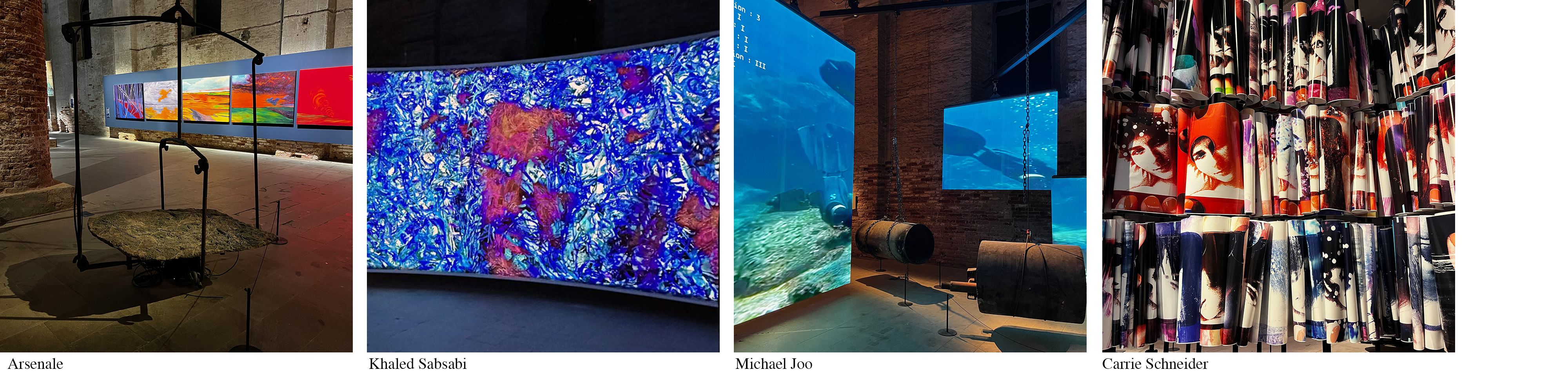
The works installed in the the first rooms of the Arsenale often set the tone for the entire exhibition. Right away viewers encounter Khaled Sabsabi's multi-media work Khalil, an eight channel video projection presented in the round intersecting with painted imagery. Sabsabi's works are also installed in the Australia Pavilion. He states that these dual presentations "continue his poetic inquiry into spiritual and everyday journeys shaped by commonality and difference." Other noteworthy installations within the Arsenale include Cauleen Smith's immersive The Wanda Coleman Songbook, a meditation on Los Angeles that uses poet Wanda Coleman's writing as a point of departure, as well as Michael Joo's installation Noospheres: Expanded where four suspended LED screens are balanced by an immense armature that includes weathered pylons. Other highlights include Carrie Schneider's photographic sculpture First Living Woman, a one-kilometer-long photograph devoted to the only moving sequence in Chris Marker's La Jetee; Sofia Gallisa Muriente's photographs and Super 8 films; as well as Kader Attia's collages and mixed media installation that juxtapose projections and ropes hung from the ceiling.
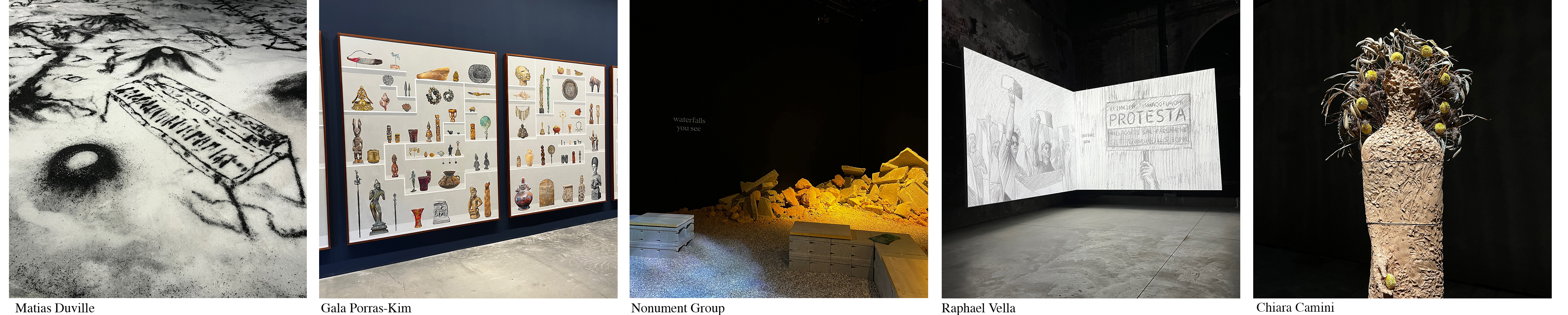
The Arsenale also houses a number of International Pavilions: standouts included Argentina with Matias Duville's installation of drawings on the floor made from salt and charcoal, RojoNegro representing Mexico, and the Applied Arts Pavilion that housed Gala Porras-Kim's evocative installation examining museum practices. I was also captivated by the Nonument Group representing the Republic of Slovenia whose piece scattered debris from past Biennales to create a new set of ruins as the backdrop for fragmented poetic and political texts projected onto black walls. The piece was an investigation of Venice's historical military and naval power. Raphael Vella representing Malta presented Praying For A Revolution That Will Never Come, a two channel video that juxtaposed more than 2000 hand drawn protest drawings culled from an archive that housed Maltese protest imagery. The softness of the line drawings in contrast with the harshness of the imagery invited pause and contemplation.
The Italian pavilion which is located toward the back of the Arsenale is easy to miss. The selected artist this year was Chiara Camini who filled the space with exotic and compelling figurative sculptures at once stoic and vulnerable.


Highlights from the Giardini were Oriol Vilanova representing Spain who covered all the walls of the pavilion from floor to ceiling with commercially produced postcards he has collected at flea markets for twenty years. The imagery was organized by dominant colors, as well as subject. While the work had both formal and conceptual rigor, seeing images of mountains, sunsets, objects and tourist attractions from all over the world was extremely satisfying.
Japan's pavilion was a bit uncanny. Ei Arkawa-Nash created an environment where visitors could "adopt" a baby and carry this doll throughout the exhibit. Titled Grass Babies, Moon Babies, the space was filled with toys, changing tables, and more than 200 dolls with different colored skin wearing brightly colored jumpsuits. Some guests hugged their dolls as if they were alive while others chose to wander the space childless.
The Dutch pavilion was a performative installation by Dries Verhoeven who transformed the usually bright and airy Gerrit Rietveld space into a dark, haunting fortress. Those willing to wait in line and be locked into a progressively darkening space for the duration of the performance experienced a confrontational and unsettling scene: a solo performer (sometimes a man, other times a woman) voicing raw grunting and sometimes indistinguishable guttural sounds as the audience sits, trapped within the space. The piece explored tensions in today's world.
While in past years painters dominated, in 2026 the only national pavilion to present a solo exhibition of paintings was Great Britain. Predicting History: Testing Translation featured quasi-narrative paintings by 2018 Turner Prize winner Lubaina Himid. Himid created a suite of multi-panel paintings featuring both domestic and pastoral scenes rendered in a careful medley of styles.
The Pavilion of the Holy See (otherwise known as the Vatican pavilion) was curated by Hans Ulrich Obrist and Ben Vickers, in collaboration with Soundwalk Collective and is located behind tall walls in a secluded and quiet garden right next to the main train station. Visitors are given headphones to wear as they wander freely around the lush grounds in a 17th century convent that is never open to the general public. Experimental music, chants and choral pieces by 24 artists ranging from Patti Smith to Brian Eno are triggered by sensors along the route.


Collateral exhibitions of note include: Helter Skelter which pairs Arthur Jafa and Richard Prince at Fondazione Prada; Trilogy of Uncertainties organized by the Fondazione In Between Art And Film and located in a 16th-Century building that once served as a hospital. Among the eight commissioned projects is Lawrence Abu Hamdan’s 15 channel video display titled 450XL: The Story of a Fugitive Sound that evocatively fragments myriad protests as they unfold across the various screens. Amar Kanwar at Palazzo Grassi and Lorna Simpson at Punta della Dogana are must sees as well. Exhibitions of works by Sherin Neshat, Man Ray and the spectacular embroideries of news photographs of the Gaza Genocide organized by Palestine Museum US at the Palazzo Mora also prove memorable.

In Minor Keys
Venice Biennale 2026
May 5 - November 22, 2026
In Minor Keys
Reviewing the Venice Biennale is always a challenge. How does one make sense of the curatorial premise of the large group exhibitions in the Arsenale and the Central Pavilion in the Giardini in relation to the various national pavilions, as well as the numerous collateral events located throughout the city. As contemporary exhibitions are often seen in relation to historic Venice, it is a delight to view them together. One of the thrills of visiting the Biennale is seeing contemporary art in old churches and otherwise closed palazzos that have been reconfigured for new exhibitions.
As always the journey through the city and all the art it has to offer is best when one has numerous days and can leisurely stroll through the great variety of locations.
In 2024, Koyo Kouoh was selected as the first African woman to curate the main exhibition. She tragically passed away a year before the Biennale was to open so a committee of her colleagues and collaborators was formed to follow through with her curatorial vision. Titled In Minor Keys, this sprawling show unfolds in two locations and includes more than 110 artists. Kouoh's democratic attitude of inclusivity pervades as the selected artists span a wide range of countries and cultures. Some were commissioned to make site specific installations, others show single or multiple works from their oeuvre. While the presentations within the Arsenale and the Central Pavilion do not exclusively represent the now, the artists selected for In Minor Keys collectively become a snapshot of art in 2026. In this time of war, protests, climate change and social injustice, the curators have successfully integrated artworks that look both forward and back in time, address conflicts and struggles world-wide, while simultaneously depicting a potentially positive image of the future.
The works installed in the the first rooms of the Arsenale often set the tone for the entire exhibition. Right away viewers encounter Khaled Sabsabi's multi-media work Khalil, an eight channel video projection presented in the round intersecting with painted imagery. Sabsabi's works are also installed in the Australia Pavilion. He states that these dual presentations "continue his poetic inquiry into spiritual and everyday journeys shaped by commonality and difference." Other noteworthy installations within the Arsenale include Cauleen Smith's immersive The Wanda Coleman Songbook, a meditation on Los Angeles that uses poet Wanda Coleman's writing as a point of departure, as well as Michael Joo's installation Noospheres: Expanded where four suspended LED screens are balanced by an immense armature that includes weathered pylons. Other highlights include Carrie Schneider's photographic sculpture First Living Woman, a one-kilometer-long photograph devoted to the only moving sequence in Chris Marker's La Jetee; Sofia Gallisa Muriente's photographs and Super 8 films; as well as Kader Attia's collages and mixed media installation that juxtapose projections and ropes hung from the ceiling.
The Arsenale also houses a number of International Pavilions: standouts included Argentina with Matias Duville's installation of drawings on the floor made from salt and charcoal, RojoNegro representing Mexico, and the Applied Arts Pavilion that housed Gala Porras-Kim's evocative installation examining museum practices. I was also captivated by the Nonument Group representing the Republic of Slovenia whose piece scattered debris from past Biennales to create a new set of ruins as the backdrop for fragmented poetic and political texts projected onto black walls. The piece was an investigation of Venice's historical military and naval power. Raphael Vella representing Malta presented Praying For A Revolution That Will Never Come, a two channel video that juxtaposed more than 2000 hand drawn protest drawings culled from an archive that housed Maltese protest imagery. The softness of the line drawings in contrast with the harshness of the imagery invited pause and contemplation.
The Italian pavilion which is located toward the back of the Arsenale is easy to miss. The selected artist this year was Chiara Camini who filled the space with exotic and compelling figurative sculptures at once stoic and vulnerable.
Highlights from the Giardini were Oriol Vilanova representing Spain who covered all the walls of the pavilion from floor to ceiling with commercially produced postcards he has collected at flea markets for twenty years. The imagery was organized by dominant colors, as well as subject. While the work had both formal and conceptual rigor, seeing images of mountains, sunsets, objects and tourist attractions from all over the world was extremely satisfying.
Japan's pavilion was a bit uncanny. Ei Arkawa-Nash created an environment where visitors could "adopt" a baby and carry this doll throughout the exhibit. Titled Grass Babies, Moon Babies, the space was filled with toys, changing tables, and more than 200 dolls with different colored skin wearing brightly colored jumpsuits. Some guests hugged their dolls as if they were alive while others chose to wander the space childless.
The Dutch pavilion was a performative installation by Dries Verhoeven who transformed the usually bright and airy Gerrit Rietveld space into a dark, haunting fortress. Those willing to wait in line and be locked into a progressively darkening space for the duration of the performance experienced a confrontational and unsettling scene: a solo performer (sometimes a man, other times a woman) voicing raw grunting and sometimes indistinguishable guttural sounds as the audience sits, trapped within the space. The piece explored tensions in today's world.
While in past years painters dominated, in 2026 the only national pavilion to present a solo exhibition of paintings was Great Britain. Predicting History: Testing Translation featured quasi-narrative paintings by 2018 Turner Prize winner Lubaina Himid. Himid created a suite of multi-panel paintings featuring both domestic and pastoral scenes rendered in a careful medley of styles.
The Pavilion of the Holy See (otherwise known as the Vatican pavilion) was curated by Hans Ulrich Obrist and Ben Vickers, in collaboration with Soundwalk Collective and is located behind tall walls in a secluded and quiet garden right next to the main train station. Visitors are given headphones to wear as they wander freely around the lush grounds in a 17th century convent that is never open to the general public. Experimental music, chants and choral pieces by 24 artists ranging from Patti Smith to Brian Eno are triggered by sensors along the route.
Collateral exhibitions of note include: Helter Skelter which pairs Arthur Jafa and Richard Prince at Fondazione Prada; Trilogy of Uncertainties organized by the Fondazione In Between Art And Film and located in a 16th-Century building that once served as a hospital. Among the eight commissioned projects is Lawrence Abu Hamdan’s 15 channel video display titled 450XL: The Story of a Fugitive Sound that evocatively fragments myriad protests as they unfold across the various screens. Amar Kanwar at Palazzo Grassi and Lorna Simpson at Punta della Dogana are must sees as well. Exhibitions of works by Sherin Neshat, Man Ray and the spectacular embroideries of news photographs of the Gaza Genocide organized by Palestine Museum US at the Palazzo Mora also prove memorable.