October 8, 2026
Tacita Dean
FILM
Marciano Art Foundation
September 18, 2026 – February 27, 2027
Tacita Dean
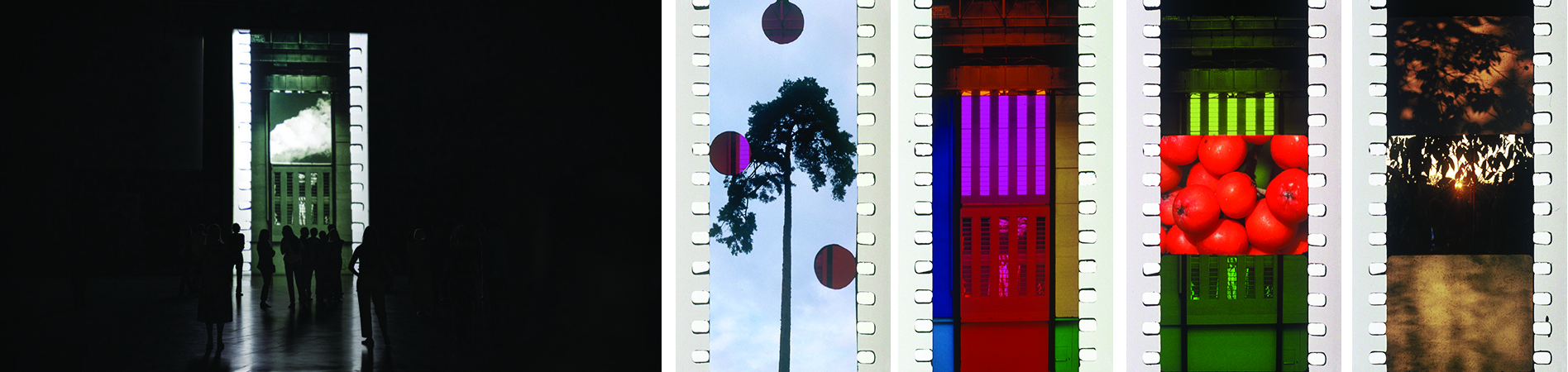
Originally commissioned by London's Tate Modern for an exhibition in the Turbine Hall in 2011, Tacita Dean’s monumental work FILM is now on view at the Marciano Art Foundation. FILM is an eleven minute, 35mm film that is projected vertically onto a thirty-one-foot-tall monolith. It is a towering presence in the back of the otherwise dark, cavernous space. Much has been written about Dean's use of an anamorphic lens which she turned 90 degrees to transform the horizontal proportions of the CinemaScope display into a gigantic vertical image. FILM was created at a time when digital technologies began to replace film and processing that traditional stock was becoming difficult. This is why it was important to Dean that FILM was analogue — shot with a film camera and developed with chemicals. Dean's intention was to celebrate the beauty, as well as the historical importance of analogue film.
While Dean often exhibits photographs, collages, drawings and paintings, she is just as comfortable working in film as she is with more static materials. Though creating a film is not as immediate as photography, it allows her to spend time with her subjects and for the narrative to unfold slowly. She states, "The time in my films is the time of film itself." Many of her films are non narrative or abstract, but she has also created numerous 16mm film "portraits." These include a piece about the late Sydney Felsen which was recently on view at Marian Goodman Gallery in Los Angeles. She has also filmed Merce Cunningham performing John Cage's composition Stillness, in addition to documenting the artists Mario Merz, David Hockney, Cy Twombly and Julie Mehretu ( both working alone, as well as in dialogue with Luchita Hurtado). While Dean's films are about both time and the mechanics of making a film, they are also sensitive and in depth portraits of her subjects — be it a person, an event, or the landscape. For example, Pan Amicus (2021) was as much about the Getty's collections as it was about the physical location of the museum.
Late in 2010, Dean was introduced to the obscure 1944 novel Mount Analogue by René Daumal and it became the jumping off point for her Turbine Hall commission. Mount Analogue is the story of an invisible peak somewhere in the South Pacific Ocean: it is real for some and a fantasy for others. Dean combined the idea of the mountain top — an imposing and seductive vertical presence — with Maya Deren's notion of vertical cinema — "a cinema without linear or horizontal narrative but one that played with the temporal, spatial, and symbolic meaning in art and poetry, [with] the film camera as its tool." This became the conceptual storyboard for FILM. Dean is also an avid collector of flea market postcards and while thinking about the mountain form from Mount Analogue she happened upon a postcard of the Matterhorn. She created a collage (now lost) that juxtaposed the Matterhorn with the sea around Helgoland, a German archipelago in the North Sea. This collage became the jumping off point for the creation of a giant vertical film. By adding sprocket holes to the sides of the image, she suddenly realized she had created a strip of film and the portrait she was destined to make would become a "portrait of film."
To produce FILM non-digitally, Dean was determined to shoot everything in camera and researched lens and antiquated devices used for superimposition from the early days of cinema. Her experiments ranged from complex masking to adding color by painting on glass gels placed in front of the camera. It was also crucial for Dean that the apparatus required to project FILM was visible to viewers as this was further validation of the analogue process. She acknowledges that while digital technology has some advantages, it is not necessarily better. For Dean, film is not a technology, but a medium. Through the presentation of FILM, she voices the necessity to save the medium and its many unique attributes.
So what is FILM? It is a 35mm moving picture with an eleven-minute duration. It has no obvious beginning or end as it is displayed in a continuous loop. The imagery is often divided vertically into thirds. Within it are images of mountains and trees and eyeballs and windows from the interior of the Turbine Hall in realistic, as well as distorted colors. There are geometric shapes and abstract patterns that spin and morph into one another. Objects appear and then sometimes move from the top to the bottom or cover the entire frame, only to then disappear. The sense of size and scale of the subject matter continually shifts. FILM is a collage that intersperses moving and static images. It is a kaleidoscopic, visual poem that has its own internal rhythm. FILM is also silent. It is a celebration of what can be achieved when one delves into the nuanced nature of celluloid.
The continually shifting clips include mountain tops in triplicate tinted red against a blue striped background. There is a cluster of mushrooms that transition from cyan to pink. There are Mondrian-esque compositions — images of windows and facades — filled with bright colors. There is a giant ostrich egg that takes over the entire frame. Color imagery desaturates to black and white. Bolts of lightening appear. Leaves at the top of trees blow in the wind. Through large round holes occasional interrupting the composition, unrelated scenes come into focus, creating foreground/background, now/later and past/present dichotomies. A lightbulb turns on, then off. In one instant an orange rectangle covers part of the scene, it relates to an image of tomatoes shown later on. Dean focuses on a moving escalator and its lines become an op-art abstraction. There are flowers, there are fabricated sunsets. There is light, as well as dark. The sequence of imagery is obtuse, ambiguous, visually engaging and almost intoxicating.
To say that FILM has no real "narrative" is both true and false. While it is not a portrait of a person or a place, it certainly is about the Turbine Hall which becomes the main character of Dean's quasi-narrative. Upon multiple viewings more and more is revealed. What Dean wants to communicate is that the medium of film is unique and should be savored, not erased and replaced by all things digital. In that sense, FILM is magical.
FILM
Marciano Art Foundation
September 18, 2026 – February 27, 2027
Tacita Dean
Originally commissioned by London's Tate Modern for an exhibition in the Turbine Hall in 2011, Tacita Dean’s monumental work FILM is now on view at the Marciano Art Foundation. FILM is an eleven minute, 35mm film that is projected vertically onto a thirty-one-foot-tall monolith. It is a towering presence in the back of the otherwise dark, cavernous space. Much has been written about Dean's use of an anamorphic lens which she turned 90 degrees to transform the horizontal proportions of the CinemaScope display into a gigantic vertical image. FILM was created at a time when digital technologies began to replace film and processing that traditional stock was becoming difficult. This is why it was important to Dean that FILM was analogue — shot with a film camera and developed with chemicals. Dean's intention was to celebrate the beauty, as well as the historical importance of analogue film.
While Dean often exhibits photographs, collages, drawings and paintings, she is just as comfortable working in film as she is with more static materials. Though creating a film is not as immediate as photography, it allows her to spend time with her subjects and for the narrative to unfold slowly. She states, "The time in my films is the time of film itself." Many of her films are non narrative or abstract, but she has also created numerous 16mm film "portraits." These include a piece about the late Sydney Felsen which was recently on view at Marian Goodman Gallery in Los Angeles. She has also filmed Merce Cunningham performing John Cage's composition Stillness, in addition to documenting the artists Mario Merz, David Hockney, Cy Twombly and Julie Mehretu ( both working alone, as well as in dialogue with Luchita Hurtado). While Dean's films are about both time and the mechanics of making a film, they are also sensitive and in depth portraits of her subjects — be it a person, an event, or the landscape. For example, Pan Amicus (2021) was as much about the Getty's collections as it was about the physical location of the museum.
Late in 2010, Dean was introduced to the obscure 1944 novel Mount Analogue by René Daumal and it became the jumping off point for her Turbine Hall commission. Mount Analogue is the story of an invisible peak somewhere in the South Pacific Ocean: it is real for some and a fantasy for others. Dean combined the idea of the mountain top — an imposing and seductive vertical presence — with Maya Deren's notion of vertical cinema — "a cinema without linear or horizontal narrative but one that played with the temporal, spatial, and symbolic meaning in art and poetry, [with] the film camera as its tool." This became the conceptual storyboard for FILM. Dean is also an avid collector of flea market postcards and while thinking about the mountain form from Mount Analogue she happened upon a postcard of the Matterhorn. She created a collage (now lost) that juxtaposed the Matterhorn with the sea around Helgoland, a German archipelago in the North Sea. This collage became the jumping off point for the creation of a giant vertical film. By adding sprocket holes to the sides of the image, she suddenly realized she had created a strip of film and the portrait she was destined to make would become a "portrait of film."
To produce FILM non-digitally, Dean was determined to shoot everything in camera and researched lens and antiquated devices used for superimposition from the early days of cinema. Her experiments ranged from complex masking to adding color by painting on glass gels placed in front of the camera. It was also crucial for Dean that the apparatus required to project FILM was visible to viewers as this was further validation of the analogue process. She acknowledges that while digital technology has some advantages, it is not necessarily better. For Dean, film is not a technology, but a medium. Through the presentation of FILM, she voices the necessity to save the medium and its many unique attributes.
So what is FILM? It is a 35mm moving picture with an eleven-minute duration. It has no obvious beginning or end as it is displayed in a continuous loop. The imagery is often divided vertically into thirds. Within it are images of mountains and trees and eyeballs and windows from the interior of the Turbine Hall in realistic, as well as distorted colors. There are geometric shapes and abstract patterns that spin and morph into one another. Objects appear and then sometimes move from the top to the bottom or cover the entire frame, only to then disappear. The sense of size and scale of the subject matter continually shifts. FILM is a collage that intersperses moving and static images. It is a kaleidoscopic, visual poem that has its own internal rhythm. FILM is also silent. It is a celebration of what can be achieved when one delves into the nuanced nature of celluloid.
The continually shifting clips include mountain tops in triplicate tinted red against a blue striped background. There is a cluster of mushrooms that transition from cyan to pink. There are Mondrian-esque compositions — images of windows and facades — filled with bright colors. There is a giant ostrich egg that takes over the entire frame. Color imagery desaturates to black and white. Bolts of lightening appear. Leaves at the top of trees blow in the wind. Through large round holes occasional interrupting the composition, unrelated scenes come into focus, creating foreground/background, now/later and past/present dichotomies. A lightbulb turns on, then off. In one instant an orange rectangle covers part of the scene, it relates to an image of tomatoes shown later on. Dean focuses on a moving escalator and its lines become an op-art abstraction. There are flowers, there are fabricated sunsets. There is light, as well as dark. The sequence of imagery is obtuse, ambiguous, visually engaging and almost intoxicating.
To say that FILM has no real "narrative" is both true and false. While it is not a portrait of a person or a place, it certainly is about the Turbine Hall which becomes the main character of Dean's quasi-narrative. Upon multiple viewings more and more is revealed. What Dean wants to communicate is that the medium of film is unique and should be savored, not erased and replaced by all things digital. In that sense, FILM is magical.