June 11, 2026
Hospital of Emotions
St. Vincent Medical Center
May 27 - July 31, 2026
Hospital of Emotions
St. Vincent Medical Center has been closed for many years. It was founded in 1856 and became Los Angeles' first city hospital. Located just outside of downtown, the rooms are still equipped with beds and equipment, but is empty of people and activity as they await renovation by a private investment group. Curated by the organization House of Art and Dreams, three floors of the building have been repurposed into the Hospital of Emotions, an installation featuring site specific projects by over seventy artists. The works are loosely categorized by emotional states ranging from joy to resilience to sadness to gratitude, to hope, to compassion, to anger to love. The selected artists were invited to make works responding to these themes and install them in the empty hospital rooms while using or displacing whatever remaining furniture was there.
The sophistication and impact of the rooms varies greatly. Some predictably house happy stuffed animals or the remnants of medical procedures. Others illustrate the fear of entering or being inside a hospital. Viewers are welcomed into the facility by a "faux" doctor in a white coat. They are checked in and given a "patient emotional chart" to fill out as they traverse the numerous installations. Upon exiting, visitors are discharged: their charts stamped as they leave the facility. Depending on whether one starts on the top or bottom floor of the exhibit, there is an opportunity to visit a both a gift shop and a flower shop where one can purchase wonderful bouquets of hand-made pipe-cleaner flowers or trinkets by selected artists as keepsakes of the experience.
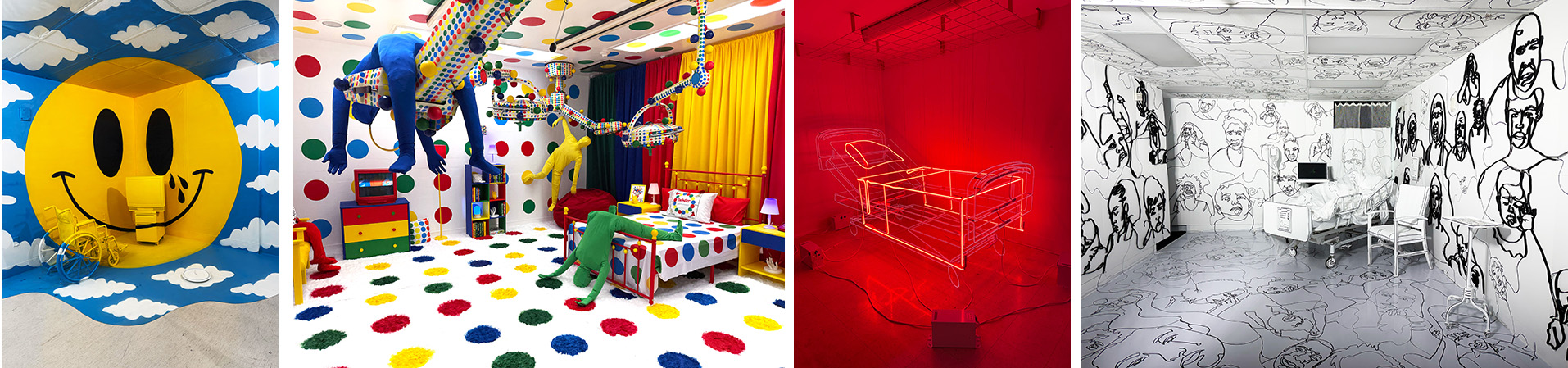
In some ways, the experience of Hospital of Emotions parallels exhibitions like Luna Luna or Immersive Van Gogh, spectacles organized around an idea or an artist, that despite being costly to attend, draw large crowds. That being said, the Hospital of Emotions features new site specific works commissioned for the exhibition and during my visit, many of the artists were there to eagerly explain the motivations behind their creations. Starting on the top floor, one begins in the Resilience Department where artists address the ability to adapt, recover and grow in the face of illness. Allison Reber transforms her hospital room into a living garden filled with moss and flowers. David Otis Johnson creates a neon hospital bed that fills the room with a glowing red aura. Madeline Verbica's space features a freestanding, moveable, structure covered with transparent images of plants and animals.
Resilience gives way to Joy where again one encounters a rooms filled with flowers (Lisa Waud's installation, or Yarra Sach's empty bed surrounded by IVs with colorful fluids). Joy and Sadness share the fifth floor. At this point it becomes difficult to differentiate the emotions as sometimes what is presented as Joy could just as easily be seen as Sadness. Javiera Estrada's room is a play on the game "Twister" where red, green, yellow and blue stuffed figures are draped across walls and carpets floors covered by like colored circles. In the Sadness department, Tommii Lim paints a huge smiley face with tears, surrounded by puffy white clouds against a blue background. Heriberto Gomes fills his room with cardboard boxes, even replacing the bed and pillow with these generic brown shapes. Maryam Trebeau's room becomes a three dimensional drawing where the walls are covered with myriad faces that cycle through stages of light and darkness. Installations addressing Hope, Compassion and Anger are located on the fourth floor whereas Love and Fear are on the third. Here, one encounters Kamil Czapiga's room b floor to ceiling with colorful video monitors displaying cell-like creatures. The Fear department brings to life rooms with monsters like in the installation by Dioz, or as in Dongpu Ling's transparent floating figures. Notions of claustrophobia pervade in Grisha Stephanian's installation where the walls are completely covered with numerous black and white xeroxes and drawings showing every possible emotion.
It is no doubt that the participating artists went all out in conceptualizing and creating their installations. Some rooms are quiet and contemplative. Some are dense and even scary. Together they articulate the range of emotions associated with health, hospitals and beyond. The experience is exhausting and overwhelming but also inspiring as the different approaches to the themes and each artist's dedication to their craft is a testament to the power of art.
St. Vincent Medical Center
May 27 - July 31, 2026
Hospital of Emotions
St. Vincent Medical Center has been closed for many years. It was founded in 1856 and became Los Angeles' first city hospital. Located just outside of downtown, the rooms are still equipped with beds and equipment, but is empty of people and activity as they await renovation by a private investment group. Curated by the organization House of Art and Dreams, three floors of the building have been repurposed into the Hospital of Emotions, an installation featuring site specific projects by over seventy artists. The works are loosely categorized by emotional states ranging from joy to resilience to sadness to gratitude, to hope, to compassion, to anger to love. The selected artists were invited to make works responding to these themes and install them in the empty hospital rooms while using or displacing whatever remaining furniture was there.
The sophistication and impact of the rooms varies greatly. Some predictably house happy stuffed animals or the remnants of medical procedures. Others illustrate the fear of entering or being inside a hospital. Viewers are welcomed into the facility by a "faux" doctor in a white coat. They are checked in and given a "patient emotional chart" to fill out as they traverse the numerous installations. Upon exiting, visitors are discharged: their charts stamped as they leave the facility. Depending on whether one starts on the top or bottom floor of the exhibit, there is an opportunity to visit a both a gift shop and a flower shop where one can purchase wonderful bouquets of hand-made pipe-cleaner flowers or trinkets by selected artists as keepsakes of the experience.
In some ways, the experience of Hospital of Emotions parallels exhibitions like Luna Luna or Immersive Van Gogh, spectacles organized around an idea or an artist, that despite being costly to attend, draw large crowds. That being said, the Hospital of Emotions features new site specific works commissioned for the exhibition and during my visit, many of the artists were there to eagerly explain the motivations behind their creations. Starting on the top floor, one begins in the Resilience Department where artists address the ability to adapt, recover and grow in the face of illness. Allison Reber transforms her hospital room into a living garden filled with moss and flowers. David Otis Johnson creates a neon hospital bed that fills the room with a glowing red aura. Madeline Verbica's space features a freestanding, moveable, structure covered with transparent images of plants and animals.
Resilience gives way to Joy where again one encounters a rooms filled with flowers (Lisa Waud's installation, or Yarra Sach's empty bed surrounded by IVs with colorful fluids). Joy and Sadness share the fifth floor. At this point it becomes difficult to differentiate the emotions as sometimes what is presented as Joy could just as easily be seen as Sadness. Javiera Estrada's room is a play on the game "Twister" where red, green, yellow and blue stuffed figures are draped across walls and carpets floors covered by like colored circles. In the Sadness department, Tommii Lim paints a huge smiley face with tears, surrounded by puffy white clouds against a blue background. Heriberto Gomes fills his room with cardboard boxes, even replacing the bed and pillow with these generic brown shapes. Maryam Trebeau's room becomes a three dimensional drawing where the walls are covered with myriad faces that cycle through stages of light and darkness. Installations addressing Hope, Compassion and Anger are located on the fourth floor whereas Love and Fear are on the third. Here, one encounters Kamil Czapiga's room b floor to ceiling with colorful video monitors displaying cell-like creatures. The Fear department brings to life rooms with monsters like in the installation by Dioz, or as in Dongpu Ling's transparent floating figures. Notions of claustrophobia pervade in Grisha Stephanian's installation where the walls are completely covered with numerous black and white xeroxes and drawings showing every possible emotion.
It is no doubt that the participating artists went all out in conceptualizing and creating their installations. Some rooms are quiet and contemplative. Some are dense and even scary. Together they articulate the range of emotions associated with health, hospitals and beyond. The experience is exhausting and overwhelming but also inspiring as the different approaches to the themes and each artist's dedication to their craft is a testament to the power of art.