October 29, 2026
Fabiola Menchelli
our sharp line of sight
Marshall Gallery
September 11 - November 7, 2026
Fabiola Menchelli
Fabiola Menchelli is a Mexico City based artist who primarily makes camera-less photographs, something akin to color photograms. Her images may at first appear to be simple studies of form and color, as they are created by folding photosensitive paper in the darkroom and exposing it to colored enlarger light. Menchelli's process turns out to be more complex, labor intensive and unpredictable than simply placing objects onto photo paper. Her creativity blossoms in the darkroom where she folds the paper in total darkness and exposes sections of it to enlarger light. She also changes the orientation of the paper during exposure and it is this movement, as well as her subtle choreography of the color filters, that makes the resulting images so unique.
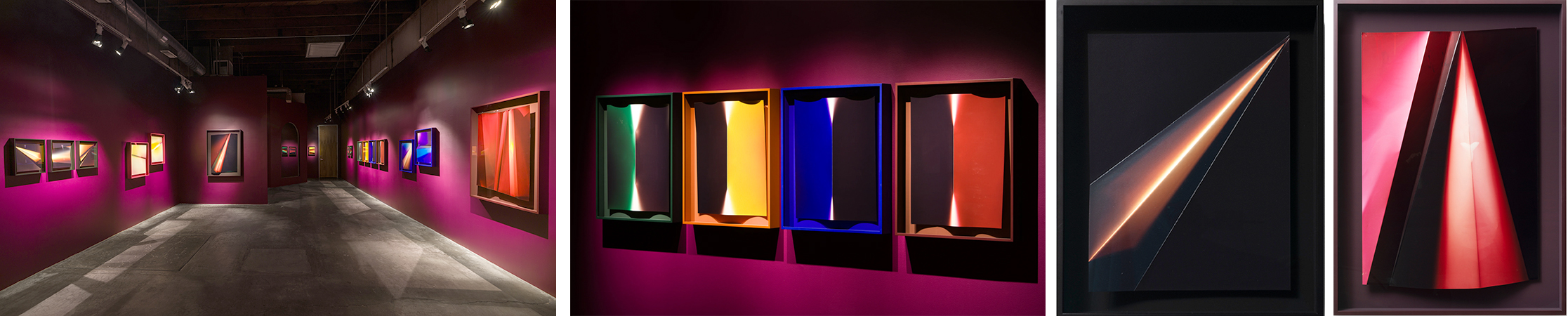
Spot lit across deep maroon/magenta walls are more than two dozen unique prismatic, camera-less chromogenic works. Though essentially a "photographer," Menchelli shares concerns with the California Light and Space artists who were interested in the ways light and volume could be captured, represented and experienced, as well as how it shaped human perception. While many California Light and Space artists created sculptures or room-sized installations, Menchelli's framed photographic prints have a dimensionality that parallels the impact of more sculptural works. Many of the individual works are presented in groupings across the walls allowing viewers to notice subtle differences between them. For example, three 14 x 11 inch pieces (all 2026) are hung side-by-side on a wall separated by only a few inches. They have been folded in such a way that they form triangular shapes that angle outward to the left and right. The brightest areas are light orange-yellow gradually deepening into brown toward the edges. Together, the works suggest the movement of a flare or comet in the night sky. Looking closely, it becomes evident that the different colors are bordered by folds in the paper that form either a light or dark line in the composition, depending on whether that section of the surface was exposed to light.
In the colorful array of five images named holding light (2026), the undulation of the paper is more pronounced. Each 24 x 20 inch sheet has a central crease that begins as a white line and then branches out near the top and bottom of the image to become an elongated and abstracted hourglass. One side of each image is a deep black, while the other is a single color: maroon, yellow, blue, green or orange. The works are mounted inside custom wood frames painted to correspond with the brightest color in each image. Because the photographic paper is not completely flat but compressed within deep frames, the folds cast shadows which make them even more evocative.
Among the larger works is the magenta/rose/red hued with your hand on my back (2024), an image filled with different colored triangular shapes that overlap and undulate within the custom frame. One can imagine Menchelli wrestling with the oversized paper in the darkroom while twisting and turning to expose different aspects of the paper to the filtered light, trying not to keep her fingers from interrupting the continuum of light. Like its counterparts soft boundaries, blind knots, and our sharp line of sight, this image illustrates a private performance. The resulting images document not an external subject but an action: movement across and through light.
Menchelli discusses her work through the language of photography. Despite being imageless and subjectless, these works remain deeply concerned with the fundamental properties of the medium: light, exposure, surface, time, and gesture. Menchelli has said that she is interested in perception and optics, in the possibilities of seeing, as well as understanding what makes seeing possible. Her darkroom experiments turn those questions into physical form. By manipulating paper, light, color, and shadow, she produces sensual images that are simultaneously photographs, objects, and traces of actions. They make visible not simply what we see, but the conditions that allow us to see.
our sharp line of sight
Marshall Gallery
September 11 - November 7, 2026
Fabiola Menchelli
Fabiola Menchelli is a Mexico City based artist who primarily makes camera-less photographs, something akin to color photograms. Her images may at first appear to be simple studies of form and color, as they are created by folding photosensitive paper in the darkroom and exposing it to colored enlarger light. Menchelli's process turns out to be more complex, labor intensive and unpredictable than simply placing objects onto photo paper. Her creativity blossoms in the darkroom where she folds the paper in total darkness and exposes sections of it to enlarger light. She also changes the orientation of the paper during exposure and it is this movement, as well as her subtle choreography of the color filters, that makes the resulting images so unique.
Spot lit across deep maroon/magenta walls are more than two dozen unique prismatic, camera-less chromogenic works. Though essentially a "photographer," Menchelli shares concerns with the California Light and Space artists who were interested in the ways light and volume could be captured, represented and experienced, as well as how it shaped human perception. While many California Light and Space artists created sculptures or room-sized installations, Menchelli's framed photographic prints have a dimensionality that parallels the impact of more sculptural works. Many of the individual works are presented in groupings across the walls allowing viewers to notice subtle differences between them. For example, three 14 x 11 inch pieces (all 2026) are hung side-by-side on a wall separated by only a few inches. They have been folded in such a way that they form triangular shapes that angle outward to the left and right. The brightest areas are light orange-yellow gradually deepening into brown toward the edges. Together, the works suggest the movement of a flare or comet in the night sky. Looking closely, it becomes evident that the different colors are bordered by folds in the paper that form either a light or dark line in the composition, depending on whether that section of the surface was exposed to light.
In the colorful array of five images named holding light (2026), the undulation of the paper is more pronounced. Each 24 x 20 inch sheet has a central crease that begins as a white line and then branches out near the top and bottom of the image to become an elongated and abstracted hourglass. One side of each image is a deep black, while the other is a single color: maroon, yellow, blue, green or orange. The works are mounted inside custom wood frames painted to correspond with the brightest color in each image. Because the photographic paper is not completely flat but compressed within deep frames, the folds cast shadows which make them even more evocative.
Among the larger works is the magenta/rose/red hued with your hand on my back (2024), an image filled with different colored triangular shapes that overlap and undulate within the custom frame. One can imagine Menchelli wrestling with the oversized paper in the darkroom while twisting and turning to expose different aspects of the paper to the filtered light, trying not to keep her fingers from interrupting the continuum of light. Like its counterparts soft boundaries, blind knots, and our sharp line of sight, this image illustrates a private performance. The resulting images document not an external subject but an action: movement across and through light.
Menchelli discusses her work through the language of photography. Despite being imageless and subjectless, these works remain deeply concerned with the fundamental properties of the medium: light, exposure, surface, time, and gesture. Menchelli has said that she is interested in perception and optics, in the possibilities of seeing, as well as understanding what makes seeing possible. Her darkroom experiments turn those questions into physical form. By manipulating paper, light, color, and shadow, she produces sensual images that are simultaneously photographs, objects, and traces of actions. They make visible not simply what we see, but the conditions that allow us to see.