October 1, 2026
John Baldessari
Sculptures
Sprueth Magers
September 11 - October 24, 2026
John Baldessari
When John Baldessari passed away in 2020 at the age of 89, it was a huge loss for Los Angeles as well as the greater art world. Baldessari was not only an inspiring artist, teacher and mentor, he was also an avid looker who cared very much about seeing art by others. We often crossed paths on our Saturday gallery rounds in Los Angeles, new York and abroad, and I would enjoy seeing John's warm, sly, all knowing smile. Wandering through his current exhibition of sculptures, (as well as video and photographic works in the upstairs space) made the loss even more apparent as I wondered what he might make now and how he'd react artistically to our current political climate.
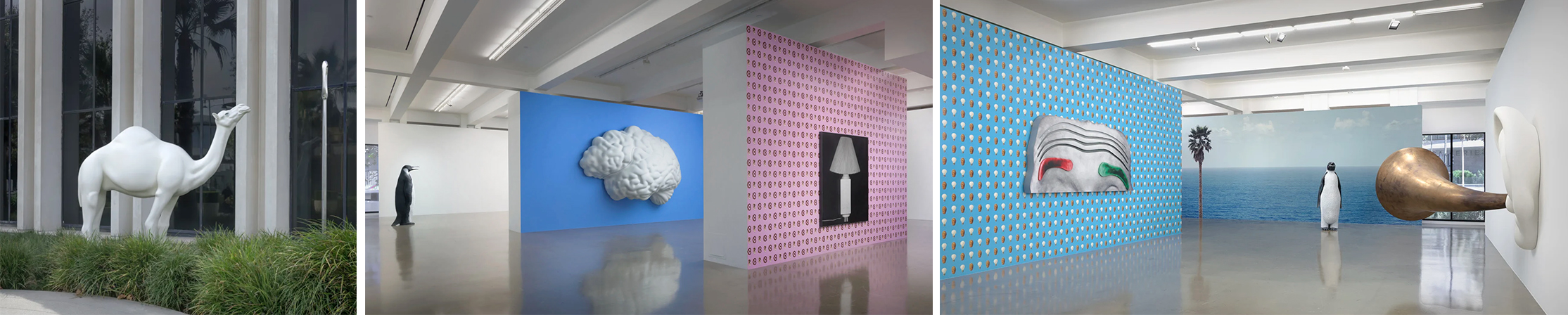
Though billed as an exhibition of sculptures, many of these three-dimensional works are presented in conjunction with large-scale photographs or patterned wallpaper that offsets the sculptures in surprising ways. That being said, the first work on the checklist Camel (Albino) Contemplating Needle (Large) 2013 is not located inside the gallery, rather it is outside the building enjoying its time in "nature." A stark white camel with bright blue eyes, stands eight-feet tall, or just a bit shorter than the oversized needle with which it is paired. Baldessari brings to light the absurdity in the biblical reference, "it is easier for a camel to pass through the eye of a needle than for a rich man to enter the kingdom of God." Other oversized objects within the exhibition include Fake Carrot (2015) and Penguin (2018). The eight foot long Fake Carrot is hung high on a wall and appears to be floating, its orange tip and green leaves dangling toward the floor. The Penguin stands still with its mouth ajar. Enlarged to at least double or triple the normal height of an actual penguin, the sculpture feels out of place and vulnerable, despite the fact that it is situated in front of an ocean background.
Many of the sculptures on view illustrate not only Baldessari's unique way of making three-dimensional forms, but how important it was to contextualize them in relation to two-dimensional imagery. He was equally interested in the sculptural object and the ways these objects are perceived in physical space. Raised Eyebrows/Furrowed Foreheads (Part One): (Red and Green Eyebrows), 2008 is a cutout fragment of a man's upper forehead culled from a found film still and enlarged to gigantic proportions. It is presented on a freestanding wall atop a wallpaper grid that juxtaposes two unrelated but visually similar objects — a lightbulb and a potato — set against a cyan background. The wrinkled forehead and raised brows may be a sign of befuddlement or an idea which take visual form through the wallpaper.
Beethoven's Trumpet (with Ear) Opus #135, 2007 and Brain Cloud (Two Views) With Palm Tree and Seascapes, 2009 are the standouts in the exhibition. Like many of the other works, these pieces are enlarged body parts stripped of all color and fabricated from resin, foam or fiberglass. Both are mounted to the wall and interactive in different ways. The huge white ear in Beethoven's Trumpet is fashioned with a replica of an old fashioned hearing aid based on Beethoven's actual listening device. Clapping or shouting into the earpiece triggers musical fragments from Beethoven's late composition to briefly fill the gallery. For Brain Cloud, Baldessari created a massive white brain which spans a wall painted bright blue. Adjacent to the sculpture covering another wall is a large photographic mural of a palm tree in front of the sea. The brain signs for the absent puffy white clouds that often dot the sky while alluding to notions of "brain fog" or "head in the clouds," examples of Baldessari's famous word play. A hidden video camera captures viewers in front of the brain and projects this image back on the opposite wall with a disorienting slight delay.To further contextualize the sculptures, a selection of photographs and videos created between 1972 and 2012 are on view in the upper gallery. These works give viewers less familiar with the arc of Baldessari's career a chance to understand his sophisticated wit and humor, as well as the numerous ways he cut apart and recombined appropriated images. The lamp seen in Black Lamp (With Three Choices) 1991, two colored photographs with paint, references the giant photographic diptych Lamp (Rotterdam #2) 1997-1998 downstairs. It is installed there over pink wallpaper filled with a grid alternating ears and pretzels: RMS W VU (Ear Pretzel-Pink), 1998. Similarly, the cutout forehead in Raised Eyebrows/Furrowed Foreheads (Part One): With Safe 2008 links to the oversized forehead and eyebrows seen on the first floor.
Baldessari often reused images so it is not surprising that what appears in a small-scale photograph might then become a large-size wall relief. While his sculptural objects investigate human forms and body parts, Baldessari was also known for his witty juxtapositions and poignant social commentary. In the pre-digital era, he regularly rephotographed and enlarged film stills, often cutting out sections to create new narratives across multiple images. He also masked parts of images by painting circles over faces and turning the narrative photograph into an abstraction. He was formally brilliant and had a knack for directing the eye across a composition, inserting a conceptual vigor into the his assemblages of disparate photographs. Baldessari embraced digital technology which allowed for more seamless collaging, as well as endless reproductions at myriad scales.
This openness to technology is evident in Brain Cloud as stated above, but can also be seen in the early black and white video Teaching a Plant the Alphabet (1972). Projected on a wall in the upper gallery, Baldessari's hand is shown holding children's alphabet cards to a potted plant. He says each letter out loud with an expectation that the plant might somehow respond. The video is an exercise in futility and an early example of Baldessari's ongoing interest in how images acquire and produce meaning. Wandering through the exhibition, one is reminded of Baldessari's genius, as well as his dedication not only to craft, but to generating whimsical reflections through seemingly random juxtapositions and omissions.
Sculptures
Sprueth Magers
September 11 - October 24, 2026
John Baldessari
When John Baldessari passed away in 2020 at the age of 89, it was a huge loss for Los Angeles as well as the greater art world. Baldessari was not only an inspiring artist, teacher and mentor, he was also an avid looker who cared very much about seeing art by others. We often crossed paths on our Saturday gallery rounds in Los Angeles, new York and abroad, and I would enjoy seeing John's warm, sly, all knowing smile. Wandering through his current exhibition of sculptures, (as well as video and photographic works in the upstairs space) made the loss even more apparent as I wondered what he might make now and how he'd react artistically to our current political climate.
Though billed as an exhibition of sculptures, many of these three-dimensional works are presented in conjunction with large-scale photographs or patterned wallpaper that offsets the sculptures in surprising ways. That being said, the first work on the checklist Camel (Albino) Contemplating Needle (Large) 2013 is not located inside the gallery, rather it is outside the building enjoying its time in "nature." A stark white camel with bright blue eyes, stands eight-feet tall, or just a bit shorter than the oversized needle with which it is paired. Baldessari brings to light the absurdity in the biblical reference, "it is easier for a camel to pass through the eye of a needle than for a rich man to enter the kingdom of God." Other oversized objects within the exhibition include Fake Carrot (2015) and Penguin (2018). The eight foot long Fake Carrot is hung high on a wall and appears to be floating, its orange tip and green leaves dangling toward the floor. The Penguin stands still with its mouth ajar. Enlarged to at least double or triple the normal height of an actual penguin, the sculpture feels out of place and vulnerable, despite the fact that it is situated in front of an ocean background.
Many of the sculptures on view illustrate not only Baldessari's unique way of making three-dimensional forms, but how important it was to contextualize them in relation to two-dimensional imagery. He was equally interested in the sculptural object and the ways these objects are perceived in physical space. Raised Eyebrows/Furrowed Foreheads (Part One): (Red and Green Eyebrows), 2008 is a cutout fragment of a man's upper forehead culled from a found film still and enlarged to gigantic proportions. It is presented on a freestanding wall atop a wallpaper grid that juxtaposes two unrelated but visually similar objects — a lightbulb and a potato — set against a cyan background. The wrinkled forehead and raised brows may be a sign of befuddlement or an idea which take visual form through the wallpaper.
Beethoven's Trumpet (with Ear) Opus #135, 2007 and Brain Cloud (Two Views) With Palm Tree and Seascapes, 2009 are the standouts in the exhibition. Like many of the other works, these pieces are enlarged body parts stripped of all color and fabricated from resin, foam or fiberglass. Both are mounted to the wall and interactive in different ways. The huge white ear in Beethoven's Trumpet is fashioned with a replica of an old fashioned hearing aid based on Beethoven's actual listening device. Clapping or shouting into the earpiece triggers musical fragments from Beethoven's late composition to briefly fill the gallery. For Brain Cloud, Baldessari created a massive white brain which spans a wall painted bright blue. Adjacent to the sculpture covering another wall is a large photographic mural of a palm tree in front of the sea. The brain signs for the absent puffy white clouds that often dot the sky while alluding to notions of "brain fog" or "head in the clouds," examples of Baldessari's famous word play. A hidden video camera captures viewers in front of the brain and projects this image back on the opposite wall with a disorienting slight delay.To further contextualize the sculptures, a selection of photographs and videos created between 1972 and 2012 are on view in the upper gallery. These works give viewers less familiar with the arc of Baldessari's career a chance to understand his sophisticated wit and humor, as well as the numerous ways he cut apart and recombined appropriated images. The lamp seen in Black Lamp (With Three Choices) 1991, two colored photographs with paint, references the giant photographic diptych Lamp (Rotterdam #2) 1997-1998 downstairs. It is installed there over pink wallpaper filled with a grid alternating ears and pretzels: RMS W VU (Ear Pretzel-Pink), 1998. Similarly, the cutout forehead in Raised Eyebrows/Furrowed Foreheads (Part One): With Safe 2008 links to the oversized forehead and eyebrows seen on the first floor.
Baldessari often reused images so it is not surprising that what appears in a small-scale photograph might then become a large-size wall relief. While his sculptural objects investigate human forms and body parts, Baldessari was also known for his witty juxtapositions and poignant social commentary. In the pre-digital era, he regularly rephotographed and enlarged film stills, often cutting out sections to create new narratives across multiple images. He also masked parts of images by painting circles over faces and turning the narrative photograph into an abstraction. He was formally brilliant and had a knack for directing the eye across a composition, inserting a conceptual vigor into the his assemblages of disparate photographs. Baldessari embraced digital technology which allowed for more seamless collaging, as well as endless reproductions at myriad scales.
This openness to technology is evident in Brain Cloud as stated above, but can also be seen in the early black and white video Teaching a Plant the Alphabet (1972). Projected on a wall in the upper gallery, Baldessari's hand is shown holding children's alphabet cards to a potted plant. He says each letter out loud with an expectation that the plant might somehow respond. The video is an exercise in futility and an early example of Baldessari's ongoing interest in how images acquire and produce meaning. Wandering through the exhibition, one is reminded of Baldessari's genius, as well as his dedication not only to craft, but to generating whimsical reflections through seemingly random juxtapositions and omissions.