April 16, 2026
Peter Wegner
Case Studies
Marshall Gallery
March 28 - May 23, 2026
Peter Wegner
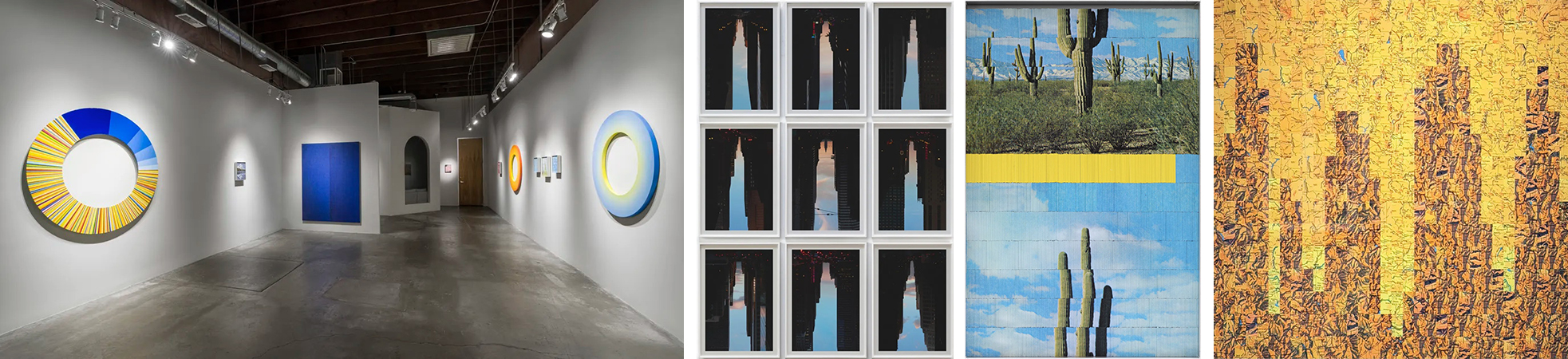
Peter Wegner is best described as a conceptual formalist. His work is precise, exacting, beautiful and elegant. His practice is not media specific, as he has created paintings, prints, sculptures, and photographs. On view at Marshall gallery are both new and old pieces created between 1999 and 2026. The oldest, Sky X / Sky Y (1999) is a large enamel paint and silkscreen diptych that from afar appears to be solid blue. Up close however, it becomes evident that the blue is comprised of colored dots (most often associated with dot screen patterns). The image is indeed the sky — but rather than depict an expansive view, Wegner has chosen to enlarge a small fragment to illustrate how in print reproduction, solids colors are never really solid.
Wegner appropriates, distorts, and creates meaning through juxtaposition. He is interested in the poetics of language as well as the poetics of form. In a series of early works he explored color names, reproducing paint chips and combining them into columns and grids. He was interested in why different hues would have the same name, as well as associations between similar shades and their distinct, yet arbitrary names. "We think we know what a color is, what a word means,” he says. “But the simplest things elude us. They are contingent, defined by circumstances."
In his ongoing series Buildings Made of Sky he photographs rows of skyscrapers, often in silhouette against the lighter blue skies that exists between the buildings. These images are presented upside-down and often in large grids, so that the negative spaces take parallel the shape of the buildings becoming a different depiction of the city. As he states, "Walking down the street in New York one day, I glanced up and saw an invisible building suspended between the others. It was upside down, the color of air... I felt that I had stumbled upon a secret city, luminous and strange… In this city, the buildings are made of sky."
A similar strategy is employed to create Reverse Atlas V (2009). Here, Wegner also begins with a given, somehow takes it apart, and then puts it back together, anew. In this series, Wegner works with maps, cutting the printed geography into fragments that are reassembled to foreground patterns and shapes — configurations that ignore borders and boundaries — and become geometric abstractions.
In a new series Case Studies, Wegner uses photography to create sculptural works. Rather than making flat images, Wegner prints on the edges of thin slats of polystyrene. Just a few pixels wide, these fragment are collected within an anodized aluminum case, thus the name Case Studies. It is difficult not to associate the title with the Case Study Houses, a program that commissioned noted architects to design and build efficient, low cost, "modern" homes, most of which were located in Southern California. These became iconic structures that are coveted to this day. Wegner takes a different approach. He begins with generic, banal images found in field guides or nature magazines of cacti, mountains or sunsets. These appropriated images are digitally printed onto the edges of the polystyrene in a block that can be rearranged and modified. Yellow Divided by Cactus, Cactus Divided by Yellow, Sky Divided by Sky and Sky Divided by Yellow (all 2026) come from the same original image. Cactus Divided by Yellow is 17.5 x 12 x 2.25 inches and is made up of 8,640 tiny sheets packed into twelve rows. The top half of the image — the first five rows — is a desert landscape filled with cacti in the foreground and mountains toward the back. Below is a mostly yellow row that ends in sky blue. Below that is, what is in actuality, the top of the original photograph with the tips of the cacti against white clouds and a blue sky. Nothing is rigid in the artwork as the picture is formed as a collection of thin lines or strata that when combined, cohere as a whole.
In Yellow Divided by Cactus, Wegner begins with the same image, this time either inserting slats of yellow into each row or reconfiguring the positions of clouds and sky to interrupt the integrity of the image. The source for Sky Divided by Sky and Sky Divided by Yellow is a fragment of sky from the cacti photograph. Related, are a series of circular paintings — Daylight 2 (2014), Daylight 3 (2014) and Color Wheel 32 (2022). Seeing the two Daylight paintings — gradients of color across large circular rings with hues that reflect the colors of the sky — alongside the Case Study works are indicative of Wegner's genius and the myriad ways he distills an image into pure color.
Wegner's fascination with edges, architecture and the relationship between two and three-dimensional surfaces are core to his pursuits. His works are direct, and sometime obtuse. They are smart and beautiful. Wegner speaks about his works and his process in formal as well as conceptual terms but allows the viewer to fill in the blanks. He is interested in spaces between, and what is inferred from what is depicted, as he states, "It’s dragging things from invisibility across the threshold of visibility, that most intrigues me as an artist."
Case Studies
Marshall Gallery
March 28 - May 23, 2026
Peter Wegner
Peter Wegner is best described as a conceptual formalist. His work is precise, exacting, beautiful and elegant. His practice is not media specific, as he has created paintings, prints, sculptures, and photographs. On view at Marshall gallery are both new and old pieces created between 1999 and 2026. The oldest, Sky X / Sky Y (1999) is a large enamel paint and silkscreen diptych that from afar appears to be solid blue. Up close however, it becomes evident that the blue is comprised of colored dots (most often associated with dot screen patterns). The image is indeed the sky — but rather than depict an expansive view, Wegner has chosen to enlarge a small fragment to illustrate how in print reproduction, solids colors are never really solid.
Wegner appropriates, distorts, and creates meaning through juxtaposition. He is interested in the poetics of language as well as the poetics of form. In a series of early works he explored color names, reproducing paint chips and combining them into columns and grids. He was interested in why different hues would have the same name, as well as associations between similar shades and their distinct, yet arbitrary names. "We think we know what a color is, what a word means,” he says. “But the simplest things elude us. They are contingent, defined by circumstances."
In his ongoing series Buildings Made of Sky he photographs rows of skyscrapers, often in silhouette against the lighter blue skies that exists between the buildings. These images are presented upside-down and often in large grids, so that the negative spaces take parallel the shape of the buildings becoming a different depiction of the city. As he states, "Walking down the street in New York one day, I glanced up and saw an invisible building suspended between the others. It was upside down, the color of air... I felt that I had stumbled upon a secret city, luminous and strange… In this city, the buildings are made of sky."
A similar strategy is employed to create Reverse Atlas V (2009). Here, Wegner also begins with a given, somehow takes it apart, and then puts it back together, anew. In this series, Wegner works with maps, cutting the printed geography into fragments that are reassembled to foreground patterns and shapes — configurations that ignore borders and boundaries — and become geometric abstractions.
In a new series Case Studies, Wegner uses photography to create sculptural works. Rather than making flat images, Wegner prints on the edges of thin slats of polystyrene. Just a few pixels wide, these fragment are collected within an anodized aluminum case, thus the name Case Studies. It is difficult not to associate the title with the Case Study Houses, a program that commissioned noted architects to design and build efficient, low cost, "modern" homes, most of which were located in Southern California. These became iconic structures that are coveted to this day. Wegner takes a different approach. He begins with generic, banal images found in field guides or nature magazines of cacti, mountains or sunsets. These appropriated images are digitally printed onto the edges of the polystyrene in a block that can be rearranged and modified. Yellow Divided by Cactus, Cactus Divided by Yellow, Sky Divided by Sky and Sky Divided by Yellow (all 2026) come from the same original image. Cactus Divided by Yellow is 17.5 x 12 x 2.25 inches and is made up of 8,640 tiny sheets packed into twelve rows. The top half of the image — the first five rows — is a desert landscape filled with cacti in the foreground and mountains toward the back. Below is a mostly yellow row that ends in sky blue. Below that is, what is in actuality, the top of the original photograph with the tips of the cacti against white clouds and a blue sky. Nothing is rigid in the artwork as the picture is formed as a collection of thin lines or strata that when combined, cohere as a whole.
In Yellow Divided by Cactus, Wegner begins with the same image, this time either inserting slats of yellow into each row or reconfiguring the positions of clouds and sky to interrupt the integrity of the image. The source for Sky Divided by Sky and Sky Divided by Yellow is a fragment of sky from the cacti photograph. Related, are a series of circular paintings — Daylight 2 (2014), Daylight 3 (2014) and Color Wheel 32 (2022). Seeing the two Daylight paintings — gradients of color across large circular rings with hues that reflect the colors of the sky — alongside the Case Study works are indicative of Wegner's genius and the myriad ways he distills an image into pure color.
Wegner's fascination with edges, architecture and the relationship between two and three-dimensional surfaces are core to his pursuits. His works are direct, and sometime obtuse. They are smart and beautiful. Wegner speaks about his works and his process in formal as well as conceptual terms but allows the viewer to fill in the blanks. He is interested in spaces between, and what is inferred from what is depicted, as he states, "It’s dragging things from invisibility across the threshold of visibility, that most intrigues me as an artist."