January 15, 2026
Malcolm Kenter
Composite Order
Sebastian Gladstone
January 8 - February 14, 2026
Malcolm Kenter
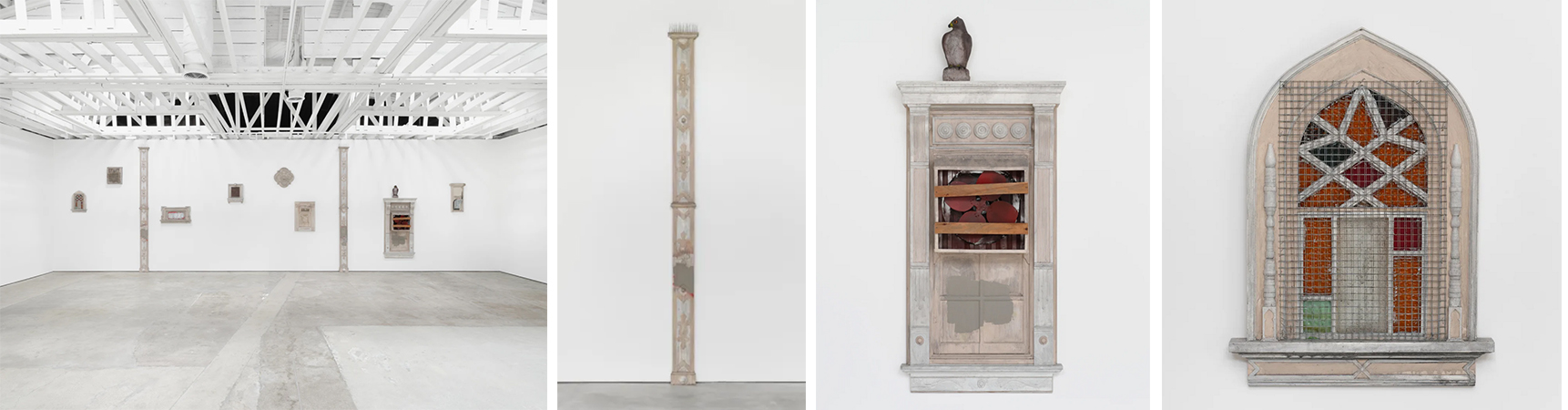
The vast space of Sebastian Gladstone gallery feels empty at first glance. On the far back wall, the San Francisco based artist Malcolm Kenter has installed what could be called an architectural intervention. Curiously, the remaining walls are blank which draws viewer's attention to the general make up of the space— its exposed beams with arched roof beyond, and the general quality of the light.
Kenter composed a text to accompany the exhibition that outlines the basis for the works and elucidating his motivations. Composite Order is historically based and combines different Greek and Roman architectural traditions, specifically where motifs of Ionic and Corinthian columns are blurred. When Kenter noticed a shuttered San Francisco storefront with a Romanesque pillar juxtaposed with a broken vent covered by duct tape, he was struck by these contrasting styles of architecture and began to take notice of similarly strange ad-hoc combinations during his wanderings across the city.
For this exhibition, he has created a series of wall based sculptures that have the qualities of throw-aways or found objects, but each is a hand made piece that replicates the patina and materials of something Kenter encountered in the streets of San Francisco. The color scheme across the works is purposely similar so they feel like they belong together, yet the entire ensemble was created specifically for the installation. Kenter's biography describes his practice as "a conceptual mining of the urban vernacular, focusing on the Bay Area’s disappearing signage, public infrastructure, and patina." It goes on to say that "Kenter replicates utility boxes, fire alarms, and other 'invisible' city materials as a form of cultural and historical preservation."
Previously, Kenter placed his replicas in the public realm where they were absorbed into the fabric of the city. As a gallery installation, the objects in Composite Order merge with the gallery's architecture. Two sculptures divide the back wall into thirds. Entitled Pilaster (A) and Pilaster (B) (all works 2025), these tall, flat vertical pieces extend from the floor toward the beams. Kenter's pilasters are carefully crafted — a combination of enamel, spray paint, and house paint, as well as wood, plastic and steel with decorative elements set into rectangular sections recalling classical designs. The pilasters are purposely painted to emphasize aging, disrepair and a dilapidated condition.
Hawk and Fan Intervention resembles a small entablature with columns and classical moulding. Set into the middle of the structure is a non-functional fan held in place with crooked wooden slats. On top of the window rests a clay hawk that appears to keep watch over the entire installation. Veiled Tracery mimics a traditional tracery — an architectural device that divides windows by bars or ribs (or screens, panels, and vaults) into sections of various proportions. In Kenter's twenty-one inch high rendition, various geometric shapes of orange, red and blue glass are nestled into rectangular and trapezoidal sections. The sculpture becomes a relic or a small altarpiece that is covered by a steel screen to protect its elements from further decay.
At once familiar, yet not specifically identifiable, Kenter's amalgamations combine architectural elements and styles. Installed at different heights along a single wall, they draw viewers to them and in many ways past them and back into the environment from which they came. The installation has an inside outside dichotomy suggesting something real and fabricated simultaneously.
Composite Order
Sebastian Gladstone
January 8 - February 14, 2026
Malcolm Kenter
The vast space of Sebastian Gladstone gallery feels empty at first glance. On the far back wall, the San Francisco based artist Malcolm Kenter has installed what could be called an architectural intervention. Curiously, the remaining walls are blank which draws viewer's attention to the general make up of the space— its exposed beams with arched roof beyond, and the general quality of the light.
Kenter composed a text to accompany the exhibition that outlines the basis for the works and elucidating his motivations. Composite Order is historically based and combines different Greek and Roman architectural traditions, specifically where motifs of Ionic and Corinthian columns are blurred. When Kenter noticed a shuttered San Francisco storefront with a Romanesque pillar juxtaposed with a broken vent covered by duct tape, he was struck by these contrasting styles of architecture and began to take notice of similarly strange ad-hoc combinations during his wanderings across the city.
For this exhibition, he has created a series of wall based sculptures that have the qualities of throw-aways or found objects, but each is a hand made piece that replicates the patina and materials of something Kenter encountered in the streets of San Francisco. The color scheme across the works is purposely similar so they feel like they belong together, yet the entire ensemble was created specifically for the installation. Kenter's biography describes his practice as "a conceptual mining of the urban vernacular, focusing on the Bay Area’s disappearing signage, public infrastructure, and patina." It goes on to say that "Kenter replicates utility boxes, fire alarms, and other 'invisible' city materials as a form of cultural and historical preservation."
Previously, Kenter placed his replicas in the public realm where they were absorbed into the fabric of the city. As a gallery installation, the objects in Composite Order merge with the gallery's architecture. Two sculptures divide the back wall into thirds. Entitled Pilaster (A) and Pilaster (B) (all works 2025), these tall, flat vertical pieces extend from the floor toward the beams. Kenter's pilasters are carefully crafted — a combination of enamel, spray paint, and house paint, as well as wood, plastic and steel with decorative elements set into rectangular sections recalling classical designs. The pilasters are purposely painted to emphasize aging, disrepair and a dilapidated condition.
Hawk and Fan Intervention resembles a small entablature with columns and classical moulding. Set into the middle of the structure is a non-functional fan held in place with crooked wooden slats. On top of the window rests a clay hawk that appears to keep watch over the entire installation. Veiled Tracery mimics a traditional tracery — an architectural device that divides windows by bars or ribs (or screens, panels, and vaults) into sections of various proportions. In Kenter's twenty-one inch high rendition, various geometric shapes of orange, red and blue glass are nestled into rectangular and trapezoidal sections. The sculpture becomes a relic or a small altarpiece that is covered by a steel screen to protect its elements from further decay.
At once familiar, yet not specifically identifiable, Kenter's amalgamations combine architectural elements and styles. Installed at different heights along a single wall, they draw viewers to them and in many ways past them and back into the environment from which they came. The installation has an inside outside dichotomy suggesting something real and fabricated simultaneously.