May 28, 2026
Lincoln Tobier
Sets of Seven Cylinders
As-Is Gallery
April 25 - May 30, 2026
Lincoln Tobier
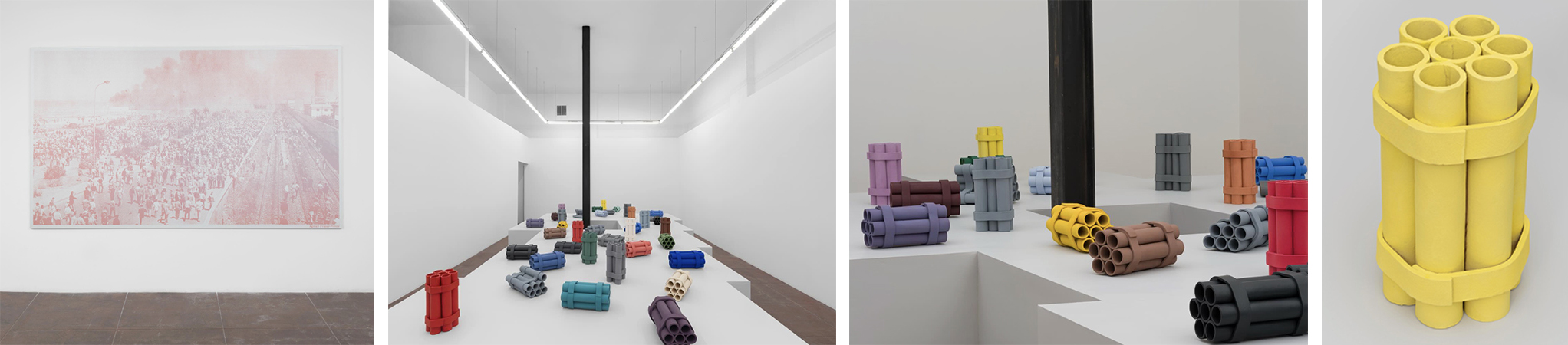
In his exhibition Sets of Seven Cylinders Lincoln Tobier presents works that are simultaneously thoughtful, beautiful, and political. This exhibition begins with a single image Tobier created in 2002 titled June 14-18, 2001. It is an enlarged newspaper photograph from the June 18, 2001 edition of The New York Times depicting an antigovernment demonstration in Algiers. Tobier has silkscreened the photograph in light pink on white enameled steel. Although it has been removed from its context (the headline and article that accompanied the oroginal image is not included), Tobier's choice feels relevant, as demonstrations like this are often front page news.
In the main space Tobier has placed thirty-seven sets of seven cylinders on a large, awkwardly shaped table that is light gray in color and stands about thigh-high. It spans the length and width of the gallery while leaving a narrow passage around the perimeter for viewers to traverse. Each group of cylinders consists of seven rolled ceramic slabs held together at either end by two ceramic bands. They are painted or glazed in vivid solid colors. Ranging from shades of gray to bright yellow, red, green or blue, they first read as a colorful array of curious circular objects. In no time, it becomes evident that he sculptures suggest bundles of dynamite (or pipe bombs) and though they are hollow and lack wicks, they are scaled to evoke the 'real thing.'
While stripped of functionality, they still allude to the destructive powers of such devices. Positioned vertically as well as horizontally along the table, the first read is that they are sculpture. The display also references the serial art practices of the 1960s, 70s and 80s, paying homage to Minimalist sculptures with repeated forms like those by Sol LeWitt, Carl Andre or Donald Judd. Though the Minimalists often repeated geometric forms or used building materials such as bricks or slabs of steel, Tobier's hand-made IED's (improvised explosive devices), are presented as serial objects in varying geometric combinations.
Why exhibit works separated by more than twenty-years? In trying to make sense of the exhibition and the relationships between the rooms, Tobier suggests a before and after trajectory. In the background of the reproduced newspaper photo is a dark billowing cloud, perhaps an explosion coinciding with the demonstration. This links the image to the oversized table filled with objects of destruction, now transformed into colorful sculptures. One becomes aware of the strangeness of the display as it relates to mass produced objects on view at toy stores or IKEA. There are other connections as well, like the fact that the image was produced in the same foundry that makes signs for the Metro in Paris and for railways throughout France.
Tobier's installation presents a dialectic between crowds and power and becomes a meditation on conflict, violence and choice— both aesthetic and tactical. He is being both playful and cunning through this juxtaposition, not only asking viewers to contemplate the past in relation to the present, but to also think about the public sphere, the news media in relation to images of violence and to question whether presenting image or objects of violence as artworks changes them in a significant way.
Sets of Seven Cylinders
As-Is Gallery
April 25 - May 30, 2026
Lincoln Tobier
In his exhibition Sets of Seven Cylinders Lincoln Tobier presents works that are simultaneously thoughtful, beautiful, and political. This exhibition begins with a single image Tobier created in 2002 titled June 14-18, 2001. It is an enlarged newspaper photograph from the June 18, 2001 edition of The New York Times depicting an antigovernment demonstration in Algiers. Tobier has silkscreened the photograph in light pink on white enameled steel. Although it has been removed from its context (the headline and article that accompanied the oroginal image is not included), Tobier's choice feels relevant, as demonstrations like this are often front page news.
In the main space Tobier has placed thirty-seven sets of seven cylinders on a large, awkwardly shaped table that is light gray in color and stands about thigh-high. It spans the length and width of the gallery while leaving a narrow passage around the perimeter for viewers to traverse. Each group of cylinders consists of seven rolled ceramic slabs held together at either end by two ceramic bands. They are painted or glazed in vivid solid colors. Ranging from shades of gray to bright yellow, red, green or blue, they first read as a colorful array of curious circular objects. In no time, it becomes evident that he sculptures suggest bundles of dynamite (or pipe bombs) and though they are hollow and lack wicks, they are scaled to evoke the 'real thing.'
While stripped of functionality, they still allude to the destructive powers of such devices. Positioned vertically as well as horizontally along the table, the first read is that they are sculpture. The display also references the serial art practices of the 1960s, 70s and 80s, paying homage to Minimalist sculptures with repeated forms like those by Sol LeWitt, Carl Andre or Donald Judd. Though the Minimalists often repeated geometric forms or used building materials such as bricks or slabs of steel, Tobier's hand-made IED's (improvised explosive devices), are presented as serial objects in varying geometric combinations.
Why exhibit works separated by more than twenty-years? In trying to make sense of the exhibition and the relationships between the rooms, Tobier suggests a before and after trajectory. In the background of the reproduced newspaper photo is a dark billowing cloud, perhaps an explosion coinciding with the demonstration. This links the image to the oversized table filled with objects of destruction, now transformed into colorful sculptures. One becomes aware of the strangeness of the display as it relates to mass produced objects on view at toy stores or IKEA. There are other connections as well, like the fact that the image was produced in the same foundry that makes signs for the Metro in Paris and for railways throughout France.
Tobier's installation presents a dialectic between crowds and power and becomes a meditation on conflict, violence and choice— both aesthetic and tactical. He is being both playful and cunning through this juxtaposition, not only asking viewers to contemplate the past in relation to the present, but to also think about the public sphere, the news media in relation to images of violence and to question whether presenting image or objects of violence as artworks changes them in a significant way.