February 12, 2026
Koichi Enomoto
Broadcast / Dreaming
Nonaka Hill Los Angeles
January 10 - February 14, 2026
Koichi Enomoto
Koichi Enomoto is a Japanese artist living outside Toyko in Kanagawa, Japan whose figurative paintings blend manga and anime-styled characters that are quirky in some ways, yet also realistic. Often combining Japanese and American references, he freely borrows from different aspects of pop culture, be it art, music, or politics. The resulting paintings simultaneously allude to the present and the past. He also has an interesting perspective on the history of art, as some of his compositions draw from Cubism and Futurism. These — specifically Chill time, alone (all works 2025) and A person who may be falsely accused — are among the highlights of the exhibition.
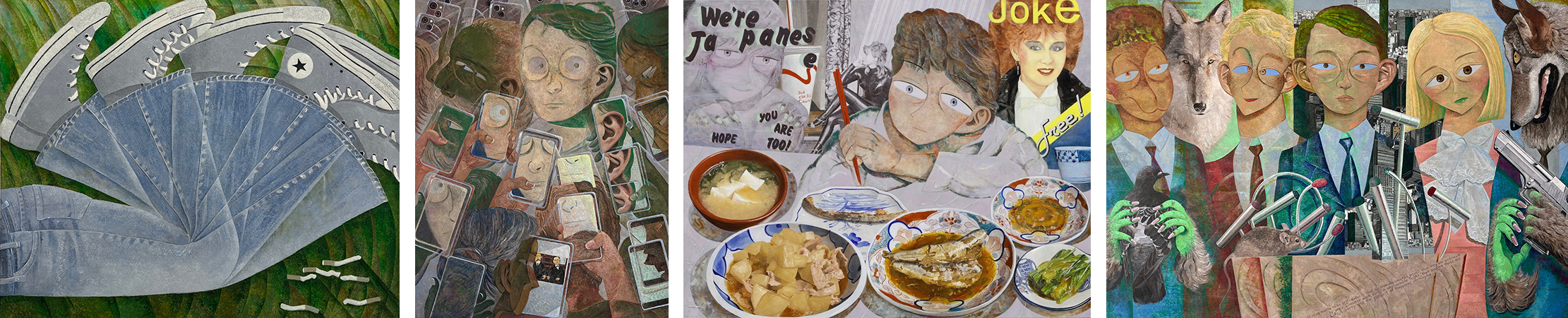
Chill time, alone immediately recalls the motion within Giacoma Balla's Dynamism of a Dog on a Leash (1912), a well known Futurist painting and an example of simultaneity via the implied movement of the feet of a little dog and the woman walking it. In Enomoto's painting, while the subject matter is different, the depiction of movement is similar. A boy wearing blue jeans and gray Converse sneakers is lying on his stomach in stylized green grass. He is depicted rocking his knee forward and back to create an arc across his body. Enomoto overlays the various positions of the leg with different levels of transparency. Six cigarette butts in the grass also reiterate this passage of time.
Another example of Enomoto's use of multiple perspectives is A person who may be falsely accused. Here, the vantage point is from behind a crowd of people all tapping on the screens of their cell phones. The crowd's focus, as well as that of the painting is a wide eyed, green haired man who looks out at the viewer with surprise. The numerous cell phone cameras display different fragment of the man's face — presumably the accused referenced in the title — ranging from his eyes, to his nose, to his ears. Almost encircling the figure from behind are cell phones facing the opposite direction so just their cameras lenses are visible. At the bottom of the painting, on one woman's phone, is a reproduction of Ben Shahn's 1932 painting Sacco and Vanzetti. The woman appears to eye the two men in the painting on her screen, then regards the accused. Sacco and Vanzetti were sentenced to death for armed robbery in 1927, though they were convicted on circumstantial evidence. Shahn created numerous paintings as an acknowledgement of the anti-immigrant fervor of the times and Enomoto's painting calls attention to similar present-day concerns.
Enomoto takes on politics in If the blind lead the blind and broadcast, politicians. Broadcast, politicians is a collage as much as it is a painting. Here, Enomoto combines cartoony figures with a more carefully rendered black and white cityscape that recedes into the background. Four "politicians" stand in front of a lectern filled with microphones. Their vacant, over-sized eyes look straight ahead. A fifth figure has the head of a wolf with green claw-like hands and carries a pistol. Another figure with a quasi-animal face and similar green claw-like hands holds a pigeon who appears to have its eyes on a rat that sits at the edge of the podium. A text with numerous misspellings inscribed diagonally on the podium reads, "We hold these truths to be self-evident that all men are created equal, that they are endowed by their Creator with certain unalienable Rights, that among these are Life, Liberty and the pursuit of Happiness — maybe." The work is playful, poignant and haunting all at once.
Alienation and loneliness pervades many of the paintings, along with a sense of dislocation. The lone eater in our dinner confronts a table filled with bowls of food. Chopsticks in hand, the cross-eyed boy can't make sense of the array as none of it is Japanese. Behind him are posters painted in different styles featuring women of different eras. The texts poke fun and contain the phrases: We're Japanese, Hope you are too!; Joke and Free! In No way, a girl clutches her cellphone and exclaims "No Way" as a figure beside her explodes from the impact of a punch. Demagogue is an ironic painting. Here, Enomoto juxtaposes a hyper-realistically painted owl and a cartoony girl. The latin letters A, B, C, D appear in the four corners of the painting, rendered in Gothic script. Two hands appear along the edges as if the girl is offering us the bird. The symbolism of the owl — wise, mysterious, as well as lucky — directs the interpretation of the work.
Enomoto is an insightful painter who seamlessly blends cultures and styles into his evocative canvases. At first glance the manga influenced figures dominate, but then one sees Picasso-esque eyes and other nods to art history, the skilled collaging of illustrative and realistic painting styles, the integration of aspects of popular culture, the insertion of self portraiture, and a borrowing from current events. The paintings demand close scrutiny and though never bombastic, they call to mind some of the ills of contemporary culture.
Broadcast / Dreaming
Nonaka Hill Los Angeles
January 10 - February 14, 2026
Koichi Enomoto
Koichi Enomoto is a Japanese artist living outside Toyko in Kanagawa, Japan whose figurative paintings blend manga and anime-styled characters that are quirky in some ways, yet also realistic. Often combining Japanese and American references, he freely borrows from different aspects of pop culture, be it art, music, or politics. The resulting paintings simultaneously allude to the present and the past. He also has an interesting perspective on the history of art, as some of his compositions draw from Cubism and Futurism. These — specifically Chill time, alone (all works 2025) and A person who may be falsely accused — are among the highlights of the exhibition.
Chill time, alone immediately recalls the motion within Giacoma Balla's Dynamism of a Dog on a Leash (1912), a well known Futurist painting and an example of simultaneity via the implied movement of the feet of a little dog and the woman walking it. In Enomoto's painting, while the subject matter is different, the depiction of movement is similar. A boy wearing blue jeans and gray Converse sneakers is lying on his stomach in stylized green grass. He is depicted rocking his knee forward and back to create an arc across his body. Enomoto overlays the various positions of the leg with different levels of transparency. Six cigarette butts in the grass also reiterate this passage of time.
Another example of Enomoto's use of multiple perspectives is A person who may be falsely accused. Here, the vantage point is from behind a crowd of people all tapping on the screens of their cell phones. The crowd's focus, as well as that of the painting is a wide eyed, green haired man who looks out at the viewer with surprise. The numerous cell phone cameras display different fragment of the man's face — presumably the accused referenced in the title — ranging from his eyes, to his nose, to his ears. Almost encircling the figure from behind are cell phones facing the opposite direction so just their cameras lenses are visible. At the bottom of the painting, on one woman's phone, is a reproduction of Ben Shahn's 1932 painting Sacco and Vanzetti. The woman appears to eye the two men in the painting on her screen, then regards the accused. Sacco and Vanzetti were sentenced to death for armed robbery in 1927, though they were convicted on circumstantial evidence. Shahn created numerous paintings as an acknowledgement of the anti-immigrant fervor of the times and Enomoto's painting calls attention to similar present-day concerns.
Enomoto takes on politics in If the blind lead the blind and broadcast, politicians. Broadcast, politicians is a collage as much as it is a painting. Here, Enomoto combines cartoony figures with a more carefully rendered black and white cityscape that recedes into the background. Four "politicians" stand in front of a lectern filled with microphones. Their vacant, over-sized eyes look straight ahead. A fifth figure has the head of a wolf with green claw-like hands and carries a pistol. Another figure with a quasi-animal face and similar green claw-like hands holds a pigeon who appears to have its eyes on a rat that sits at the edge of the podium. A text with numerous misspellings inscribed diagonally on the podium reads, "We hold these truths to be self-evident that all men are created equal, that they are endowed by their Creator with certain unalienable Rights, that among these are Life, Liberty and the pursuit of Happiness — maybe." The work is playful, poignant and haunting all at once.
Alienation and loneliness pervades many of the paintings, along with a sense of dislocation. The lone eater in our dinner confronts a table filled with bowls of food. Chopsticks in hand, the cross-eyed boy can't make sense of the array as none of it is Japanese. Behind him are posters painted in different styles featuring women of different eras. The texts poke fun and contain the phrases: We're Japanese, Hope you are too!; Joke and Free! In No way, a girl clutches her cellphone and exclaims "No Way" as a figure beside her explodes from the impact of a punch. Demagogue is an ironic painting. Here, Enomoto juxtaposes a hyper-realistically painted owl and a cartoony girl. The latin letters A, B, C, D appear in the four corners of the painting, rendered in Gothic script. Two hands appear along the edges as if the girl is offering us the bird. The symbolism of the owl — wise, mysterious, as well as lucky — directs the interpretation of the work.
Enomoto is an insightful painter who seamlessly blends cultures and styles into his evocative canvases. At first glance the manga influenced figures dominate, but then one sees Picasso-esque eyes and other nods to art history, the skilled collaging of illustrative and realistic painting styles, the integration of aspects of popular culture, the insertion of self portraiture, and a borrowing from current events. The paintings demand close scrutiny and though never bombastic, they call to mind some of the ills of contemporary culture.