October 23, 2025
Carol Bove
Nights of Cabiria
Gagosian Gallery
September 25 - November 1, 2025
Carol Bove
In Nights of Cabiria, Carol Bove transforms Gagosian Gallery into an evocative installation that parallels the architecture of the space. Bove plays off the beams and trestles that criss-cross the ceiling, transforming them into frameworks for her sculptures. Bove also references film history by naming the installation Nights of Cabiria, a 1957 film directed by Federico Fellini. It centers around the adventures of a sex worker named Cabiria living in Rome. Cabiria was also a 1914 silent classic directed by Giovanni Pastrone. In that film, Cabiria is a young Sicilian girl sold into slavery in Carthage. It was shot in Turin and set during the Second Punic War (218 to 202 BCE). According to Gagosian's press release, Cabiria is also credited with various innovations, including the first extensive use of a moving camera. While the references within Bove's installation may be obtuse, they create a conceptual structure for the installation.
Bove offers a nod to the silent film with NO (2025). Here, a small reproduction of a movie still has been screened into the center of a large yellow cloth. It hangs from the high ceiling and piles up on the floor near the gallery entrance. This soft image in many ways contrasts everything else in the space, except for Diaphanous Prison (2025), another fabric divider suspended in the back gallery. This dye on silk work features a photographic reproduction of a grid of metal chain that becomes a diaphanous wall. Excluding these two fabric pieces, the installation is otherwise hard-edged and architectural. Bove is best known as a sculptor who creates large scale works that incorporate found as well as construction-related materials. In this exhibition, she uses the formal apparatus of the gallery's architecture as a point of departure.
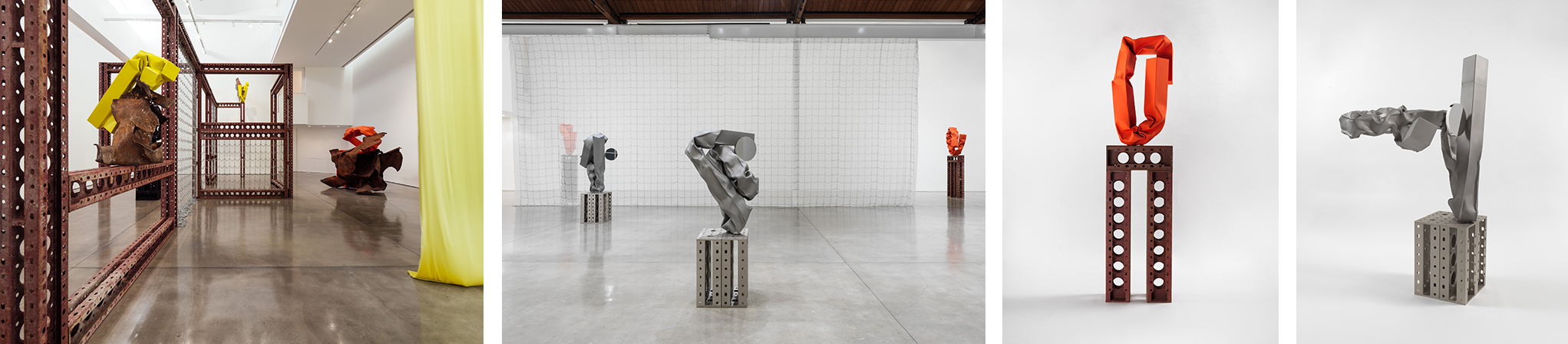
The main space is filled with rusted steel scaffolding that divides the gallery into quasi-compartments or cells. Some of the openings within the structure are empty while others are filled with a chain-link lattice that parallels the image in Diaphanous Prison. Interspersed within this architectural intervention are Bove's sculptures. Some rest on the floor while others are perched on the scaffolding. Idiopathic Abstraction (2020-25) is a large floor-based piece that combines found rusted metal and stainless steel painted bright orange, juxtaposing organic and geometric forms. There is a raw yet graceful quality in Bove's sculptures. In this work, what once might have been a rigid metal beam is now bent in the shape of a distorted "S." It's deep orange plays off the natural rust in the found steel. In Priestcraft (2025), Bove places a mangled "O" shaped steel beam also painted orange on top of steel structural scaffolding which serves as its base. At 100 inches tall the sculpture has a dominant and evocative presence.
Similar Salamander (2025) is another floor-based piece made of pristine nickel-plated steel scaffolding topped with a crumpled beam of unpainted stainless steel. In the center of the twisted and folded form is a small round mirror that reflects the gallery space as well as the viewer's image as they circle the work, placing them in its center. Similar Salamander is one of a trio of sculptures — each consisting of the same elements arranged in different ways.
The take away is strength and beauty, a consideration of surface and a mix of texture and how different treatments can inform the reading of the works. Although each sculpture is unique, the exhibition is experienced as a site-specific installation. The space has been structured to support this strange mix of pieces, which in turn inform, delight and play off each other.
Nights of Cabiria
Gagosian Gallery
September 25 - November 1, 2025
Carol Bove
In Nights of Cabiria, Carol Bove transforms Gagosian Gallery into an evocative installation that parallels the architecture of the space. Bove plays off the beams and trestles that criss-cross the ceiling, transforming them into frameworks for her sculptures. Bove also references film history by naming the installation Nights of Cabiria, a 1957 film directed by Federico Fellini. It centers around the adventures of a sex worker named Cabiria living in Rome. Cabiria was also a 1914 silent classic directed by Giovanni Pastrone. In that film, Cabiria is a young Sicilian girl sold into slavery in Carthage. It was shot in Turin and set during the Second Punic War (218 to 202 BCE). According to Gagosian's press release, Cabiria is also credited with various innovations, including the first extensive use of a moving camera. While the references within Bove's installation may be obtuse, they create a conceptual structure for the installation.
Bove offers a nod to the silent film with NO (2025). Here, a small reproduction of a movie still has been screened into the center of a large yellow cloth. It hangs from the high ceiling and piles up on the floor near the gallery entrance. This soft image in many ways contrasts everything else in the space, except for Diaphanous Prison (2025), another fabric divider suspended in the back gallery. This dye on silk work features a photographic reproduction of a grid of metal chain that becomes a diaphanous wall. Excluding these two fabric pieces, the installation is otherwise hard-edged and architectural. Bove is best known as a sculptor who creates large scale works that incorporate found as well as construction-related materials. In this exhibition, she uses the formal apparatus of the gallery's architecture as a point of departure.
The main space is filled with rusted steel scaffolding that divides the gallery into quasi-compartments or cells. Some of the openings within the structure are empty while others are filled with a chain-link lattice that parallels the image in Diaphanous Prison. Interspersed within this architectural intervention are Bove's sculptures. Some rest on the floor while others are perched on the scaffolding. Idiopathic Abstraction (2020-25) is a large floor-based piece that combines found rusted metal and stainless steel painted bright orange, juxtaposing organic and geometric forms. There is a raw yet graceful quality in Bove's sculptures. In this work, what once might have been a rigid metal beam is now bent in the shape of a distorted "S." It's deep orange plays off the natural rust in the found steel. In Priestcraft (2025), Bove places a mangled "O" shaped steel beam also painted orange on top of steel structural scaffolding which serves as its base. At 100 inches tall the sculpture has a dominant and evocative presence.
Similar Salamander (2025) is another floor-based piece made of pristine nickel-plated steel scaffolding topped with a crumpled beam of unpainted stainless steel. In the center of the twisted and folded form is a small round mirror that reflects the gallery space as well as the viewer's image as they circle the work, placing them in its center. Similar Salamander is one of a trio of sculptures — each consisting of the same elements arranged in different ways.
The take away is strength and beauty, a consideration of surface and a mix of texture and how different treatments can inform the reading of the works. Although each sculpture is unique, the exhibition is experienced as a site-specific installation. The space has been structured to support this strange mix of pieces, which in turn inform, delight and play off each other.