December 4, 2025
Camilla Taylor
Unkindness
Track 16 Gallery
November 8, 2025 - January 10, 2026
Camilla Taylor
Since the January 2025 fires, there have been numerous accounts of artists who have lost their homes and studios and the challenges they faced in resurrecting their practices, often from the ground up. What to do when everything is gone; when the pieces begun for an upcoming show are ashes, as well as family heirlooms, clothing, furniture and everything else? What is the purpose and function of art in the face of disaster?
Camilla Taylor was returning to their Altadena home on January 7, 2025 when they saw fire in the nearby mountains. Arriving home, they did not have have time to evaluate the situation, or collect treasured possessions as they rushed to safety with their husband and cats while grabbing just an overnight bag. At the time, no one who evacuated thought they'd return to nothing. In the ensuing months, Taylor was offered studio spaces, residencies, and financial support from friends and institutions. Now, eleven months later, Taylor is presenting a new body of work in an exhibition titled Unkindness.
Taylor is a sculptor and mixed media artist whose past works have investigated domestic as well as architectural spaces. They are interested in the ways figures can inhabit and interact with what surrounds them. Their evocative forms are impeccably crafted and uncanny in what they include or leave out. They are conceptually savvy and poetically metaphorical.
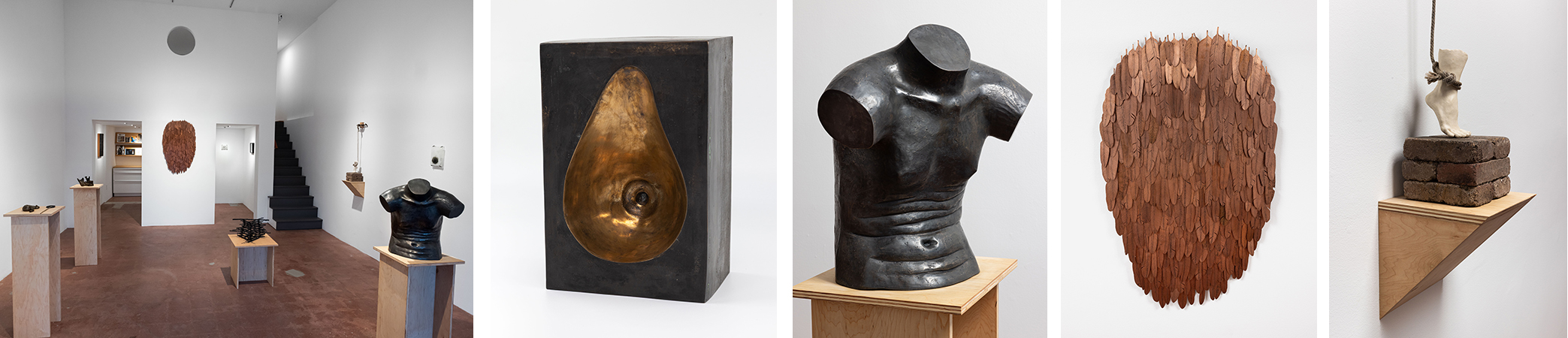
Loss pervades this exhibition. Many of he sculptures are cast in bronze. They are created from fragments or disembodied figures and allude to something made, then destroyed or badly damaged. A dominant work in the exhibit is Bereft (all works 2025), a muscular, bronze torso hunched over itself. This weighty form sits on a plywood pedestal, both present and absent simultaneously. From the front, it recalls classical sculptures, a ruin rescued and then preserved for display in a museum setting. Seen from the back, the figure is transformed into something beyond a body. A rectangular hole has been cut into the figure's backside. This cavity becomes a fountain, filled with water. Not only does the trickling liquid create a soothing sound that permeates the space, it also references the cyclical nature of life
Cruelty likewise has two views. From one side it is a dark, patinated bronze box that is filled like a relic with a single female breast. From the verso, the pear-shaped hollow impression appears to be a glowing yet haunting form: present in its absence. It signs for the rest of the body that is missing. Stray is a larger than life sized bronze replica of the human mandible (the largest and strongest bone in the face). It sits alone on a pedestal making viewers acutely aware of the upper jaw and the skull it should be attached to and inspires one to ponder what might have happened to it.
The fragments Taylor presents announce "I am still here," but also reference what is gone. Two untitled cast glass pieces, one inscribed with the word "ghost," the other with the word "rest," are semi-translucent rectangles fastened to the wall with hardware that has thick black plastic tips. Stairs is comprised of a cast ceramic foot tied at the ankle with a long rope that is suspended from a C-clamp. The foot stands on tip toe atop a pile of bricks. This ambiguous and chilling piece simultaneously suggests a chance to escape that has been thwarted, as well a safety net or a lifeline.
The wall based Fury is an oversized breastplate made of numerous hand-cut and etched thin copper feathers. Traditionally, breastplates were armor that covered the torso as a first line of defense. Taylor's breastplate offers no protection, although it is a weighty presence that ironically implies flight and lightness.
Dualities and dichotomies imbue Taylor's pieces. They are beautiful, yet also tragic. It is impossible to view the exhibition and not be reminded of Taylor's trying year, the hardships they experienced and the courage they mustered to keep going and to dig deep to create a new body of work that both looked forward and back. The exhibition is a triumph and a celebration of what is possible despite the unkindness in the world, and the uncertainties of life.
Unkindness
Track 16 Gallery
November 8, 2025 - January 10, 2026
Camilla Taylor
Since the January 2025 fires, there have been numerous accounts of artists who have lost their homes and studios and the challenges they faced in resurrecting their practices, often from the ground up. What to do when everything is gone; when the pieces begun for an upcoming show are ashes, as well as family heirlooms, clothing, furniture and everything else? What is the purpose and function of art in the face of disaster?
Camilla Taylor was returning to their Altadena home on January 7, 2025 when they saw fire in the nearby mountains. Arriving home, they did not have have time to evaluate the situation, or collect treasured possessions as they rushed to safety with their husband and cats while grabbing just an overnight bag. At the time, no one who evacuated thought they'd return to nothing. In the ensuing months, Taylor was offered studio spaces, residencies, and financial support from friends and institutions. Now, eleven months later, Taylor is presenting a new body of work in an exhibition titled Unkindness.
Taylor is a sculptor and mixed media artist whose past works have investigated domestic as well as architectural spaces. They are interested in the ways figures can inhabit and interact with what surrounds them. Their evocative forms are impeccably crafted and uncanny in what they include or leave out. They are conceptually savvy and poetically metaphorical.
Loss pervades this exhibition. Many of he sculptures are cast in bronze. They are created from fragments or disembodied figures and allude to something made, then destroyed or badly damaged. A dominant work in the exhibit is Bereft (all works 2025), a muscular, bronze torso hunched over itself. This weighty form sits on a plywood pedestal, both present and absent simultaneously. From the front, it recalls classical sculptures, a ruin rescued and then preserved for display in a museum setting. Seen from the back, the figure is transformed into something beyond a body. A rectangular hole has been cut into the figure's backside. This cavity becomes a fountain, filled with water. Not only does the trickling liquid create a soothing sound that permeates the space, it also references the cyclical nature of life
Cruelty likewise has two views. From one side it is a dark, patinated bronze box that is filled like a relic with a single female breast. From the verso, the pear-shaped hollow impression appears to be a glowing yet haunting form: present in its absence. It signs for the rest of the body that is missing. Stray is a larger than life sized bronze replica of the human mandible (the largest and strongest bone in the face). It sits alone on a pedestal making viewers acutely aware of the upper jaw and the skull it should be attached to and inspires one to ponder what might have happened to it.
The fragments Taylor presents announce "I am still here," but also reference what is gone. Two untitled cast glass pieces, one inscribed with the word "ghost," the other with the word "rest," are semi-translucent rectangles fastened to the wall with hardware that has thick black plastic tips. Stairs is comprised of a cast ceramic foot tied at the ankle with a long rope that is suspended from a C-clamp. The foot stands on tip toe atop a pile of bricks. This ambiguous and chilling piece simultaneously suggests a chance to escape that has been thwarted, as well a safety net or a lifeline.
The wall based Fury is an oversized breastplate made of numerous hand-cut and etched thin copper feathers. Traditionally, breastplates were armor that covered the torso as a first line of defense. Taylor's breastplate offers no protection, although it is a weighty presence that ironically implies flight and lightness.
Dualities and dichotomies imbue Taylor's pieces. They are beautiful, yet also tragic. It is impossible to view the exhibition and not be reminded of Taylor's trying year, the hardships they experienced and the courage they mustered to keep going and to dig deep to create a new body of work that both looked forward and back. The exhibition is a triumph and a celebration of what is possible despite the unkindness in the world, and the uncertainties of life.